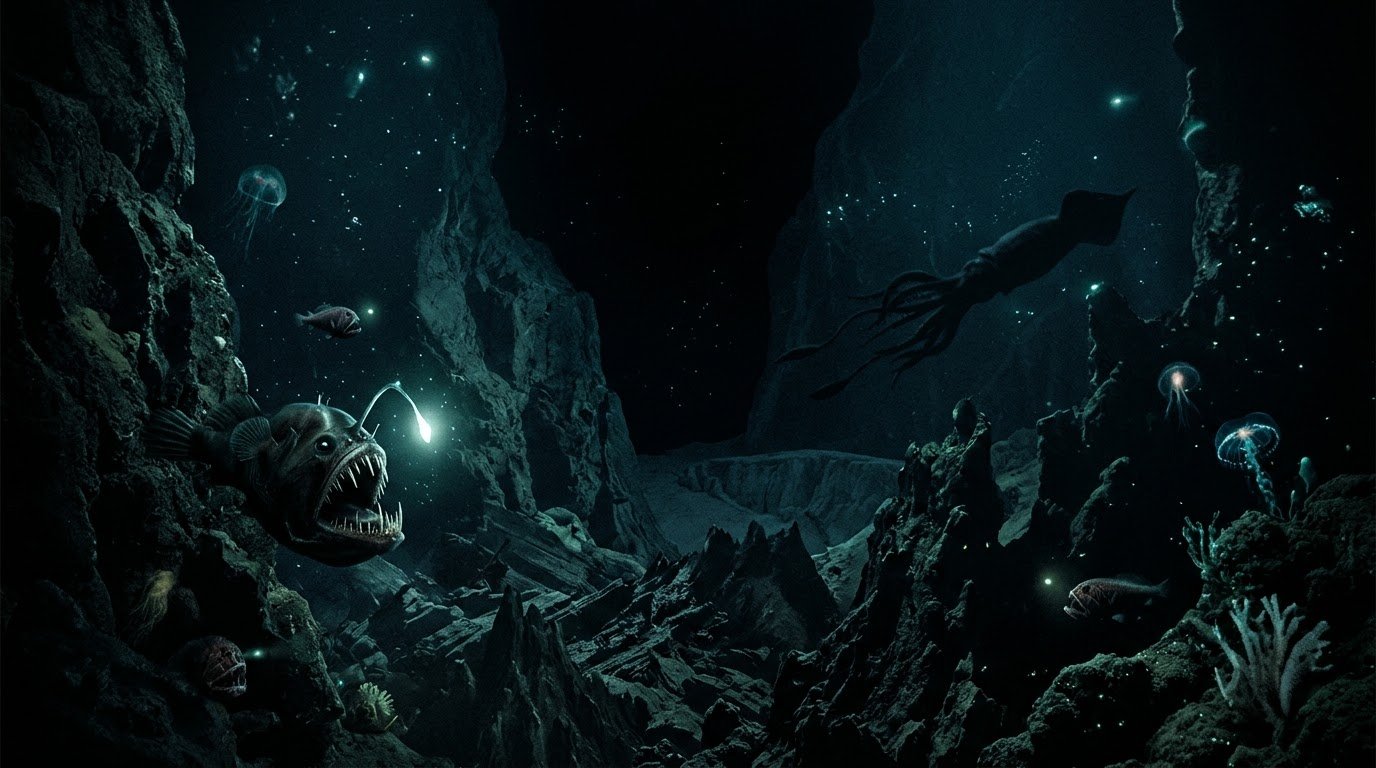
 Deep Ocean
The Abyss Speaks: Unveiling the Darkest Depths of Earth’s Oceans
Plunging beneath the shimmering blue surface of our planet lies a realm far more hostile, alien, and unexplored than the surface of the Moon. Earth’s deep ocean is a planetary vault of total darkness, crushing pressure, and freezing thermal conditions, holding secrets that stretch back to the dawn of evolutionary history.
While humanity fixates its gaze upon distant stars, thousands of meters beneath our sea level exists an ecosystem operating entirely independent of sunlight, sustained by bizarre geological engines and specialized biological adaptations that defy conventional terrestrial logic.
The deep ocean does not hide its secrets behind distance; it guards them under the crushing silence of absolute darkness and immense hydrostatic weight.
Shabab Ali
The light spectrum dies quickly as you descend into the liquid abyss, transforming the vibrant photic zone into absolute darkness within the first thousand meters. Beyond this threshold lies the bathypelagic realm, where photosynthetic plant life cannot exist and temperature hovers just above freezing. Creatures surviving in this shadow land have abandoned visual reliance on solar photons, instead evolving sophisticated sensory mechanisms such as lateral line systems to detect subtle water displacements caused by distant predators or prey.
Pressure at the ocean floor increases by approximately one atmosphere for every ten meters of depth, culminating in punishing hydro-forces within the deep oceanic trenches. At the bottom of the Mariana Trench, eleven thousand meters beneath the surface, the weight of the water column exerts over eight tons of pressure per square inch.
This extreme environment instantly collapses conventional cellular structures and implodes hollow cavities, forcing native abyssal organisms to synthesize high concentrations of trimethylamine N-oxide (TMAO) to stabilize their proteins against structural deformation.
At the bottom of the world, life does not beg for sunshine; it builds its own engines of energy out of volcanic fires and chemical fury.
Shabab Ali
Despite these unforgiving physical parameters, life thrives in the abyssal plains using chemical mechanisms that bypass solar radiation entirely. Along tectonic rift zones, hydrothermal vents known as “black smokers” spew superheated, mineral-laden fluid directly from the Earth’s mantle into the freezing water.
Specialized chemosynthetic bacteria utilize hydrogen sulfide from these volcanic plumes as a primary energy source, forming the foundational link of complex food webs that nourish giant tube worms, blind shrimp, and predatory crabs in complete isolation from the atmosphere.
Bioluminescence serves as the universal language and primary tool of survival across the bathyal and abyssal zones. Deep-sea organisms generate cold light through precise chemical reactions involving luciferin and luciferase enzymes, using these radiant displays for illumination, mate recognition, defensive distraction, or predatory lure.
The anglerfish famously exploits this mechanism by dangling a glowing photophore directly above its oversized, needle-toothed jaws, luring unsuspecting prey through the pitch-black water column into an inescapable trap.
Seeing in Darkness
Light generated chemically, without heat, to navigate and hunt where the sun will never reach.
Mate Recognition
Unique flashing patterns act as identity signals — a courtship language written in photons.
Predator Confusion
Sudden light bursts startle attackers — a decoy flash buys life-saving seconds of escape.
The Hadal zone — comprising deep ocean trenches formed by tectonic subduction — represents the ultimate biological frontier on Earth. These isolated, V-shaped chasms act as planetary island ecosystems where species evolve in hyper-localized isolation over millions of years. Amphipods inhabiting these extreme depths have developed calcified carapaces fortified with aluminum compounds to survive the relentless corrosive force of high-pressure seawater, proving that biological adaptability expands to meet even the most severe environmental stresses.
Deep-sea gigantism remains one of the most intriguing physiological phenomena observed in these pitch-black depths. Invertebrates such as the giant squid, colossal squid, and giant isopods grow to dimensions many times larger than their shallow-water relatives.
Typical Relative
Surface-dwelling shrimp-sized isopods — the small, familiar cousins of the abyssal giants.
Deep-Sea Giant
Giant isopods, colossal squid, and giant tube worms — scaled up by slower metabolism, scarce food, and delayed maturity.
Biologists attribute this dramatic scaling to a combination of lower metabolic rates, delayed sexual maturity, scarce food availability requiring large energetic reserves, and the physiological advantages of reduced cell surface area under extreme pressure.
Scavenging communities on the ocean floor rely heavily on unpredictable biological fallouts known as “marine snow” and “whale falls.” Marine snow consists of falling organic debris, dead plankton, and fecal matter drifting down from the sunlit surface like a slow, constant rain of nourishment.
When a massive whale carcass hits the abyssal sediment, it creates a localized biological jackpot, sustaining complex multi-stage ecosystems of sleeper sharks, hagfish, bone-eating worms, and microbial colonies for several decades.
Mobile Scavengers
Sleeper sharks, hagfish, and crabs strip soft tissue over the first months. The carcass feeds thousands of organisms.
Enrichment Opportunists
Polychaete worms and crustaceans colonize remaining bone and sediment. Rich organic matter fuels dense local populations.
Sulfophilic Bacteria
Bone-eating Osedax worms break down lipids. Bacterial mats convert hydrogen sulfide from the bones — sustaining life for decades.
Exploring these extreme depths requires sophisticated deep-submergence vehicles, autonomous underwater robots, and hardened sensor arrays engineered with specialized titanium hulls and synthetic syntactic foam. Instruments deployed into trenches must endure environmental stresses higher than those encountered in interplanetary spaceflight, demanding ultra-precise mechanical engineering.
Ultimately, investigating the terrifying depths of our oceans does more than expand terrestrial biology; it provides the direct blueprint for identifying potential life on icy ocean worlds elsewhere in our solar system. The extreme adaptations forged in Earth’s abyssal trenches demonstrate that life is an extraordinarily persistent planetary phenomenon.
As technology gradually illuminates the darkest corners of our planet, the deep sea stands as a profound reminder that Earth remains rich with unexplored wonder — holding answers to our planet’s past and the universe’s biological potential.
The deep sea stands as a profound reminder that Earth remains rich with unexplored wonder — holding answers to our planet’s past and the universe’s biological potential.