 Neuroscience
The Human Brain: The Most Complex Biological System We Know
Within the dark, silent vault of the skull resides a three-pound universe of unimaginable power. The human brain orchestrates every heartbeat, decodes every emotion, and stores the vast tapestry of human memory without a single instruction manual. Far exceeding the processing capacity of any supercomputer ever built, this intricate web of tissue remains the ultimate frontier of scientific discovery.
Understanding its architecture requires peering past medical jargon into the raw, dynamic reality of our neural machinery — from the microscopic spark of a single synapse to the synchronized oscillations that birth human consciousness itself.
Every cognitive act begins with an electrical spark leaping across an invisible gulf known as the synapse. Roughly eighty-six billion neurons form a tangled, living forest where thoughts physically travel as chemical messengers across microscopic gaps. Understanding this cellular architecture is the foundation of all neuroscience.
Dendrites
Delicate listening antennae catching neurotransmitter whispers from neighboring cells across microscopic gaps.
Axons
Insulated biological cables firing nerve impulses at speeds surpassing two hundred miles per hour.
Glial Cells
Outnumber neurons nearly ten to one — the unsung maintenance crews that nourish and protect our circuits.
Microglia
Immune cells patrolling neural pathways, scavenging debris and neutralizing pathogens before damage occurs.
Myelin Sheaths
Wrap tightly around axons like electrical tape, ensuring rapid signal transmission without energy leakage.
Neurotransmitters
Dopamine, serotonin, and acetylcholine govern mood, focus, motivation, and involuntary muscle contractions.
Receptor Proteins
Molecular lock-and-key gates embedded in cell membranes, determining whether a neuron fires or stays quiet.
Synaptic Plasticity
Alters the physical shape of connection points daily, allowing humans to adapt, learn, and break old habits.
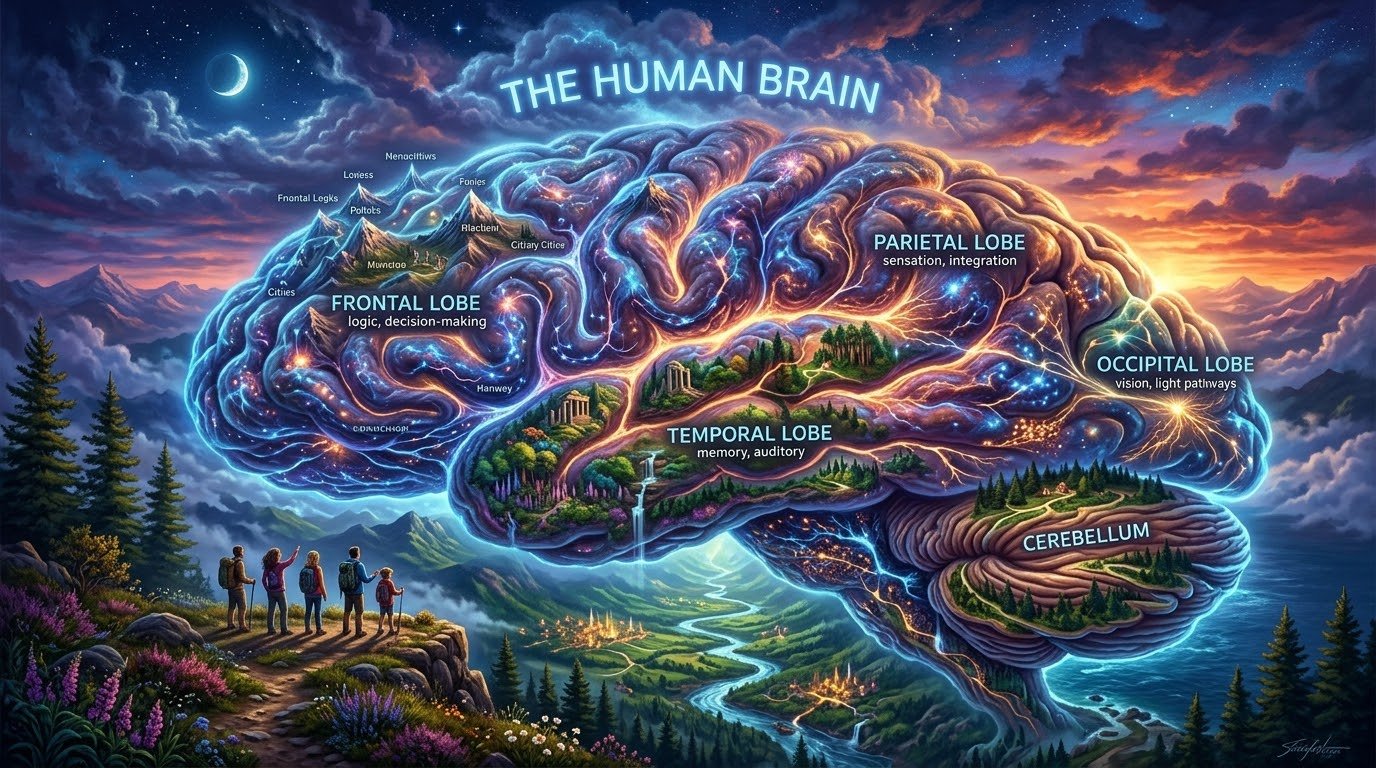
The cerebral cortex folds heavily upon itself to maximize surface area inside a remarkably restricted cranial boundary. This wrinkled topography — the brain’s landscape of gyri and sulci — houses specialized regions responsible for every facet of human experience.
Executive Command
Governs executive functioning, long-term planning, impulse control, and the complex mechanics of moral decision-making.
The motor strip along its posterior edge directs every voluntary muscle twitch with pinpoint accuracy.
Spatial Integration
Synthesizes tactile sensations, spatial awareness, and temperature data into a coherent map of physical reality.
Somatosensory regions dedicate disproportionate real estate to fingertips, lips, and the human tongue.
Visual Decoding
Decodes raw photons hitting the retina into rich visual landscapes characterized by color, depth, and motion.
The primary visual cortex at the pole transforms light patterns into meaning.
Memory & Sound
Manages auditory processing, linguistic comprehension, and the intricate filing system of episodic autobiographical memory.
The hippocampus anchors this landscape, consolidating memories into permanent cortical storage.
Emotional Alarm System
Amygdala clusters fire fear signals instantly — prioritizing raw emotional survival over logical deliberation during sudden crises.
Hemispheric Bridge
The corpus callosum bridges left and right hemispheres, transferring vast streams of data across millions of active nerve fibers.
Despite accounting for only two percent of total body weight, the resting brain consumes twenty percent of human energy. That dramatic disproportion reveals something profound: thinking is metabolically expensive, and the brain is the most power-hungry organ in the human body.
Glucose molecules serve as the primary fuel source, demanding a constant, uninterrupted supply of oxygenated blood from the heart. Astrocytes bridge blood vessels and neurons, shuttling vital nutrients directly to active cellular regions experiencing heavy cognitive loads.
Hypothalamus
Monitors systemic temperature, hormonal balances, hunger pangs, thirst cues, and circadian sleep-wake cycles flawlessly.
Pituitary Gland
Master endocrine conductor, releasing hormones that direct growth, stress response, and metabolism.
Cerebrospinal Fluid
Bathes the entire central nervous system, cushioning delicate tissue against sudden mechanical impacts and trauma.
Blood-Brain Barrier
Deploys strict molecular gatekeepers, preventing harmful toxins in the bloodstream from reaching vulnerable neural tissue.
Cortisol & Stress
Chronic stress floods the hippocampus with excess cortisol, gradually shrinking dendrites and impairing memory retrieval.
Glymphatic System
Nightly fluid-washing mechanism clearing metabolic waste products accumulated during waking hours.
Neurogenesis proves that adult brains can generate brand-new neurons within the hippocampus — defying decades of rigid neurological dogma that the adult brain is incapable of creating new cells.
The most remarkable achievement of the human brain is not raw computational throughput, but the emergence of language, memory, self-awareness, and empathy from the synchronized activity of billions of cells.
Broca’s Area
Coordinates the physical muscle movements required to produce articulate, grammatically correct spoken language effortlessly.
Wernicke’s Area
Decodes incoming auditory speech signals, translating abstract acoustic vibrations into rich, meaningful conceptual thoughts.
Working Memory
Buffers temporary information using a rigid mental scratchpad, holding roughly four distinct items for mere seconds.
Metacognition
Grants humans the rare evolutionary ability to think about thinking, evaluating personal biases and correcting cognitive blind spots.
Empathy Networks
Driven by specialized mirror neurons, allow individuals to physically feel a fraction of another person’s pain or joy.
Default Mode Network
Activates during daydreaming, mind-wandering, and self-reflection — underpinning our ongoing sense of personal identity and ego.
The Three Memory Systems
Procedural
Skills and motor routines — riding a bike, typing, playing an instrument — stored implicitly without conscious recall.
Semantic
General world knowledge — facts, concepts, meanings — independent of when or where they were learned.
Episodic
Personal experiences — the *what*, *where*, and *when* of your life — richly tied to time and context.
Consciousness remains science’s greatest unsolved mystery — arising not from a single master organ but from synchronized oscillations across vast networks. Neuroplastic rehabilitation enables stroke survivors to bypass damaged tissue entirely, rewiring alternative neural pathways to recover lost motor skills.
Primate intelligence scaled upward alongside complex social structures, requiring massive computational power to navigate tribal politics and alliances. Tool use and bipedalism freed human hands, creating a powerful feedback loop that supercharged cortical expansion across generations.
Brain-Computer Interfaces
Allow paralyzed patients to type messages and control robotic limbs using pure thought patterns alone.
Light-Based Neural Control
Light-sensitive proteins activate or silence specific neurons with laser precision in experimental laboratory settings.
Functional Imaging
Tracks real-time blood flow changes, illuminating which brain regions activate during complex problem-solving tasks.
Alzheimer’s & Parkinson’s
Highlight the devastating cost of protein misfolding and neuronal death within aging brain systems.
Targeted Interventions
Evolve treatments targeting specific receptor subtypes for severe depression, anxiety, and treatment-resistant epilepsy.
Neural Network Computing
Artificial intelligence draws heavy inspiration from neural networks, mimicking biological parallel processing in silicon.
The human brain remains the final frontier — a dense, uncharted jungle where the secrets of existence await ultimate deciphering. Every discovery rewrites what we thought we knew about ourselves.