 Cosmic Origins
The Architecture of Chaos: How 4.6 Billion Years Forged Our Cosmic Home
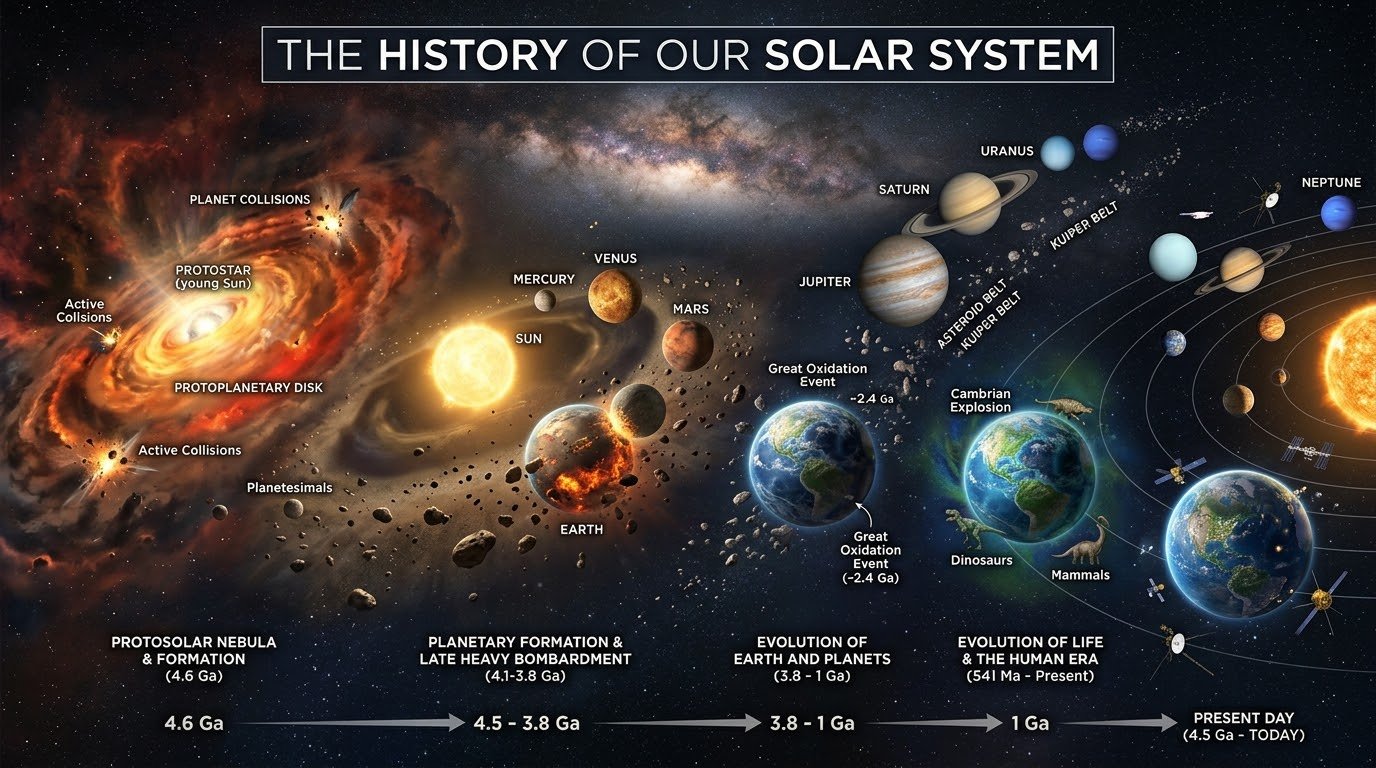
Out of a silent, drifting abyss of cold interstellar gas and ancient stellar debris, a cosmic crucible ignited 4.6 billion years ago to give birth to everything we touch, breathe, and know. Long before humanity etched marks into stone or measured the ticking of seconds, a massive nebula — a vast, frigid nursery of hydrogen, helium, and microscopic interstellar dust — began to collapse under the relentless, invisible weight of its own gravity.
This was not a gentle gathering; it was a catastrophic gravitational implosion triggered perhaps by the shockwave of a nearby dying star, a supernova that injected heavy elements into the primordial mix. As the immense cloud contracted, conservation of angular momentum forced it to spin faster and flatten into a swirling, incandescent accretion disk, churning through the dark like a celestial whirlpool. In its blinding center, hyper-dense pressure fused hydrogen atoms into helium, igniting our Sun — a newborn nuclear furnace that flooded the young solar neighborhood with light and solar wind, permanently altering the destiny of the surrounding matter.
The transition from a cold molecular cloud to a blazing star system happens with ruthless mechanical precision. Gravity amplifies tiny density variations into catastrophic collapse; angular momentum transforms a sphere into a disk; and at the center, where pressures exceed all earthly imagination, fusion begins. In a single gravitational heartbeat, a lifeless nebula becomes the beating heart of a new solar system.
Before the first footprint scarred the earth, the violent alchemy of a collapsing nebula already weighed our destiny in the palm of stardust.
Shabab Ali
At staggering distances from this central fire, where freezing temperatures reigned, volatile compounds and icy fragments aggregated into massive gaseous leviathans. Jupiter and Saturn swept through the nascent disk with immense gravitational dominance, vacuuming up colossal amounts of hydrogen and helium, while Uranus and Neptune captured icy methane, ammonia, and water cores in the frozen twilight of the outer system.
Terrestrial Worlds
Closer to the searing heat of the proto-Sun, high temperatures vaporized light gases, leaving behind only refractory elements like iron, nickel, silicates, and rock.
Through millions of years of chaotic collisions and high-speed impacts, these building blocks coalesced into four dense anchor-points.
Gas & Ice Giants
Beyond the frost line, where temperatures plunged near absolute zero, volatile compounds and icy fragments aggregated into massive gaseous leviathans.
They swept through the nascent disk with immense gravitational dominance, vacuuming up hydrogen, helium, methane, and ammonia.
Each world became a distinct laboratory of planetary evolution, shaped by volcanism, tectonic convulsions, and atmospheric stripping — a chaotic debris field forged into a family of radically different planets.
In the furnace of the inner ring, raw metal and stone fought for dominance, while distant ice giants dreamed in perpetual night.
Shabab Ali
Among this chaotic debris field orbiting at a Goldilocks distance from the Sun, our fragile blue planet found its delicate equilibrium. Earth did not inherit paradise; it endured the Hadean Eon — an apocalyptic hellscape pelted by relentless asteroid bombardment, wrapped in a suffocating carbon dioxide atmosphere, and covered by a boiling magma ocean.
Yet, as the cosmic bombardment subsided and the crust cooled, subterranean steam condensed into relentless rains that filled the primordial basins, giving birth to the first global oceans. Within these mineral-rich hydrothermal depths, complex organic molecules crossed the invisible threshold from inert chemistry into living biology. Single-celled microorganisms emerged, quietly metabolizing chemicals and releasing oxygen through photosynthesis, slowly rewriting the chemical composition of the atmosphere and paving the way for multicellular complexity.
Life was not a miracle dropped from the skies; it was the inevitable spark that caught fire when water, rock, and time collided.
Shabab Ali
The maturation of the solar system required an invisible guardian to shield fragile terrestrial life from extinction-level cosmic artillery. Jupiter, the titanic gas giant, acted as a gravitational vacuum cleaner, capturing or deflecting stray comets and life-threatening asteroids that would have otherwise obliterated Earth’s nascent biosphere.
Meanwhile, the Moon — forged in a colossal, violent impact between the young Earth and a Mars-sized interloper named Theia — stabilized our planet’s axial tilt, granting us predictable seasons, steady climate cycles, and stable tidal rhythms.
Without this giant natural satellite acting as a stabilizing anchor, Earth’s rotational axis would have wobbled wildly through chaotic extremes, rendering complex terrestrial ecosystems impossible. Every crater on the Moon’s scarred face is a silent testament to ancient impacts that our planetary shield absorbed on our behalf.
Our survival hangs by the invisible thread of a colossal shield, anchored by a Moon born from catastrophic destruction.
Shabab Ali
As eons unspooled, life clawed its way out of the oceans, conquering barren continents, branching into towering forests, and eventually giving rise to conscious awareness. The carbon locked away by ancient organisms formed fossil fuel reserves, while the shifting tectonic plates sculpted continents, mountain ranges, and deep oceanic trenches, driving evolutionary divergence through geographical isolation.
Today, humanity stands as the universe waking up to study itself — a fleeting, intelligent species capable of looking back through telescopes to read the history written in the light of distant stars.
We are not separate from the cosmos; we are literal star-stuff, our bones built from ancient supernova calcium, our blood carrying the iron forged in dying suns, and our minds reflecting the very nebula from which we emerged.
We are the universe gazing at its own reflection, built from the ashes of forgotten stars and the patience of deep time.
Shabab Ali
Looking forward, the biography of our solar system is far from finished. Billions of years from now, our Sun will exhaust its nuclear fuel and expand into a bloated red giant, consuming the inner planets and rewriting the planetary map.
Yet long before that final cosmic chapter unfolds, human ingenuity is already reaching outward, planting the seeds of space exploration on the rust-colored dunes of Mars and sending robotic emissaries beyond the Kuiper Belt into interstellar space. The journey from a blinding cloud of interstellar dust to the bustling, living world we inhabit today is the ultimate epic of transformation — a profound reminder that out of absolute chaos, nature constructs breathtaking order, beauty, and consciousness.
The story written in our DNA began in the heart of a dying star; our destiny lies waiting in the silent ocean of the stars above.
Shabab Ali
Out of absolute chaos, nature constructs breathtaking order, beauty, and consciousness — and we are the part of the universe finally awake enough to notice.
The journey from a blinding cloud of interstellar dust to the bustling, living world we inhabit today is the ultimate epic of transformation — a profound reminder that out of absolute chaos, nature constructs breathtaking order.