 Astrophysics
The Ultimate Twilight: How Stars Collapse, Explode, and Seed the Cosmos
Every glowing point in the night sky is locked in a fierce, lifelong war against its own immense gravity. From the moment a collapsing cloud of interstellar hydrogen ignites its nuclear core, a star embarks on a predictable trajectory toward inevitable extinction. Nuclear fusion acts as the outward thermal engine, pushing back against the crushing inward weight of the star’s outer layers.
This delicate equilibrium — hydrostatic equilibrium — dictates everything from a star’s surface temperature to its eventual lifespan. When the core fuel runs low, the physics of the star shifts from a steady burn to a chaotic, desperate scramble for survival.
What This Journey Will Teach You
Unpack the intricate physical mechanics governing stellar evolution and terminal death phases.
Contrast the distinct thermodynamic pathways of low-mass versus high-mass stellar demises.
Examine the violent mechanics of novae and supernovae as cosmic laboratories of nucleosynthesis.
Analyze the exotic remnants left behind, from diamond-rich white dwarfs to singularity-bound black holes.
The mass of a star serves as the ultimate arbiter of its final destiny, dividing stellar demises into quiet fading acts and catastrophic explosions. Understanding stellar death is essential because every single heavy atom in the human body was forged inside these cosmic crucibles.
A star does not merely die when its fuel is spent; it undergoes a violent metamorphosis that writes the chemical alphabet of the universe.
Shabab Ali
Stars like our Sun possess insufficient mass to trigger the high-temperature fusion stages required to forge iron or heavier elements. As hydrogen in the core depletes, the core contracts under gravity while heating up, causing the outer layers to expand dramatically into red giants. During this bloated phase, the star sheds its outer atmosphere into space, sculpting magnificent glowing envelopes known as planetary nebulae.
Left behind at the center is a dense, Earth-sized ember called a white dwarf — supported not by heat, but by quantum mechanical electron degeneracy pressure. However, if this white dwarf resides within a binary system, its story can take a sudden, highly volatile turn.
As the stolen gas compresses and heats up, it eventually triggers an explosive runaway thermonuclear reaction across the dwarf’s surface. This sudden, brilliant outburst is known as a Nova — temporarily boosting the system’s luminosity thousands of times over without destroying the core.
Unlike a total explosion, the white dwarf survives the nova event, returning to its parasitic routine until enough fuel builds up for another eruption.
A nova is a stellar thief caught in the act, stealing fuel from a neighbor until the stolen fire consumes its dignity.
Shabab Ali
For stars exceeding eight solar masses, the journey toward death is a multi-staged nuclear orchestra moving at a breakneck pace. As each fuel source — hydrogen, helium, carbon, neon, oxygen, and silicon — is exhausted in the core, gravity forces the star to ignite heavier elements. Each successive burning stage lasts exponentially shorter than the last, transforming the core into an onion-like structure of concentric nuclear fusion shells.
Silicon burning constructs an innermost core made almost entirely of iron, marking the absolute death sentence for the star. Unlike lighter elements, fusing iron does not release energy; it absorbs energy, removing the thermal pressure holding up the star. Within a fraction of a second, the iron core reaches the Chandrasekhar limit, collapsing inward at nearly a quarter of the speed of light.
Free-falling matter slams into the ultra-dense nuclear center, creating a titanic shockwave that rebounds outward through the collapsing layers. Neutrinos flood out in staggering quantities, carrying away 99% of the gravitational binding energy and helping to violently rip the star apart.
When iron enters the core, the furnace turns into an executioner, plunging the star into an irreversible, fraction-of-a-second collapse.
Shabab Ali
Astrophysicists categorize supernovae into two fundamentally different physical mechanisms, each telling a unique story about cosmic evolution. This magnificent, blinding death rattle is what we call a Supernova — outshining entire galaxies for weeks on end.
Because every Type Ia supernova explodes at nearly the exact same mass limit, they serve as “standard candles” to measure vast cosmic distances. Meanwhile, Type II, Type Ib, and Type Ic supernovae scatter freshly forged carbon, oxygen, silicon, gold, and uranium across the interstellar medium at thousands of kilometers per second.
The expanding debris shockwaves plow through surrounding gas clouds, triggering the compression needed to birth subsequent generations of new stars and planets.
The golden ring on your finger and the iron in your blood are the direct inheritance of ancient, long-dead supernovae.
Shabab Ali
What remains after the blinding flash of a core-collapse supernova depends entirely on the residual mass of the crushed stellar core.
Neutron Star
Gravity crushes electrons and protons together into a degenerate sea of pure neutrons. A single teaspoon weighs billions of tons. Some pulse as spinning lighthouses — pulsars.
Black Hole
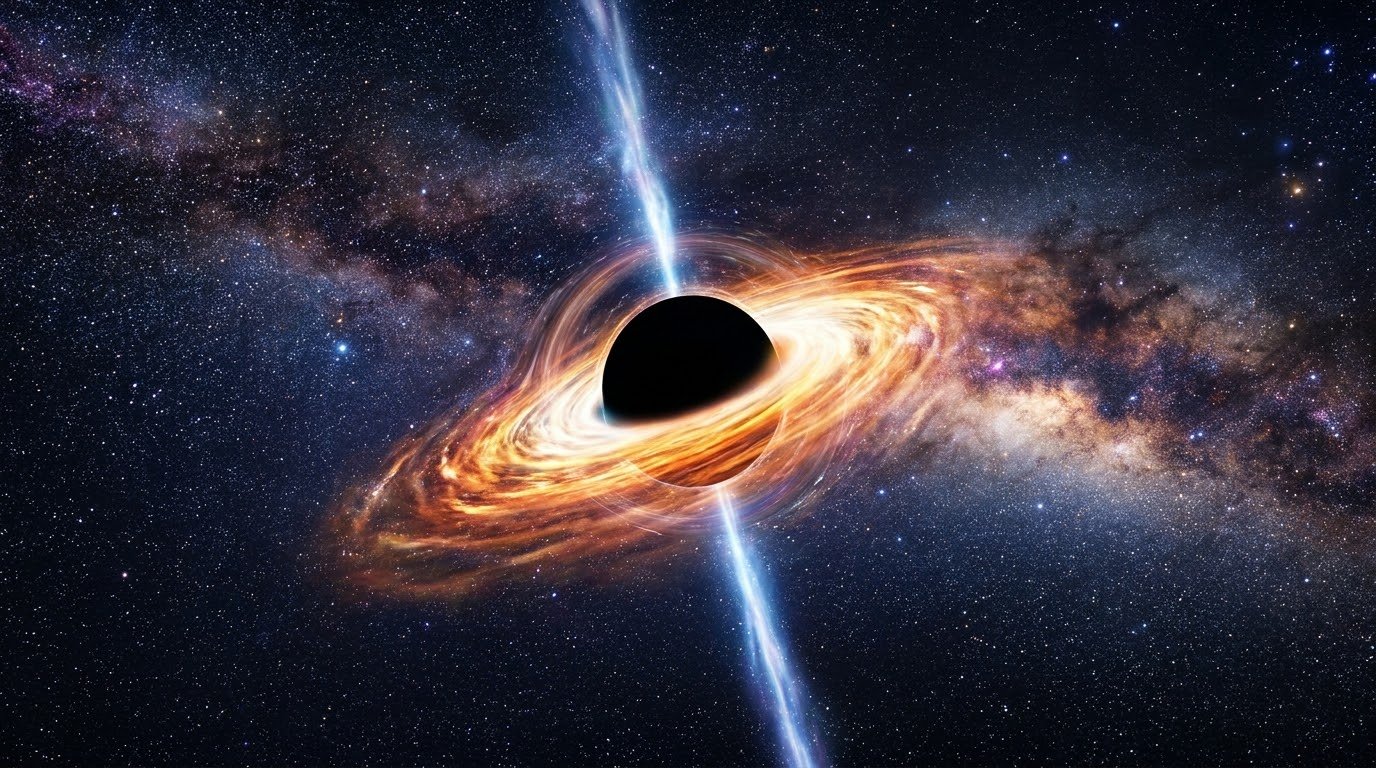
If the core exceeds 3 solar masses, nothing halts the collapse. The star vanishes behind an event horizon — where spacetime curves infinitely and light cannot escape.
These silent gravitational monsters warp the surrounding cosmos, anchoring galaxies and shaping the dynamic architecture of the universe.
At the heart of a black hole, physics whispers its deepest secrets, hiding behind an event horizon where time itself stands still.
Shabab Ali
Stellar death is never a true ending, but rather a profound transformation in the continuous lifecycle of cosmic matter. Every atom expelled by novae and supernovae drifts through interstellar space, cooling and mixing with molecular clouds over millions of years.
New solar systems coalesce out of this enriched debris, containing the complex heavy elements necessary for rocky worlds, atmospheres, and biology. We live on a planet born from the ashes of ancient stellar explosions, existing as conscious fragments of the universe exploring its own origins.
The study of novae and supernovae bridges the gap between the microscopic realm of quantum particles and the macrocosmic scale of galaxies.
As long as the universe expands and stars burn through their allotted fuel, this magnificent cycle of death and rebirth will endure without pause.
We are the temporary custodians of stardust, walking upright under the light of stars that are already ghosts of the deep past.
Shabab Ali
As long as the universe expands and stars burn through their allotted fuel, this magnificent cycle of death and rebirth will endure without pause.