 Astrophysics
Neutron Stars: The Extraordinary Objects Created When Massive Stars Collapse
The universe frequently uses catastrophic violence to forge its most breathtaking masterpieces, and nothing exemplifies this cosmic irony better than the birth of a neutron star. When a supermassive star finishes its nuclear fuel supply, it cannot sustain the outward thermal pressure required to fight its own immense weight.
In a fraction of a second, gravity wins the ultimate tug-of-war, triggering a core-collapse supernova that obliterates the outer layers of the star while crushing the inner core into a singularity of pure, unadulterated density. What remains behind is not a black hole, but a compact, spinning remnant known as a neutron star — a literal city-sized atomic nucleus floating through the dark expanse of space.
A neutron star is where the universe takes the remnants of a giant star and compresses them into a diamond of physics, shining brightest when everything else has gone dark.
Shabab Ali
The genesis of a neutron star begins deep within the core of a star at least eight to twenty times more massive than our Sun. For millions of years, nuclear fusion acts as a fierce internal furnace, fusing hydrogen into helium and progressively heavier elements until the core turns entirely into iron. Because iron fusion absorbs energy rather than releasing it, the furnace suddenly turns off, removing the outward pressure that kept the star stable against gravity.
Gravity seizes this exact moment of weakness, slamming the core inward at a quarter of the speed of light in a catastrophic implosion. As the infalling material rebounds off the degenerate iron core, a shockwave rips through the outer layers, scattering heavy elements across the cosmos in a dazzling supernova explosion. Left behind in the epicenter is a crushed residue where electrons and protons are forcibly fused together via inverse beta decay, neutralizing their charges and transforming the entire core into an ocean of tightly packed neutrons.
The resulting object packs a mass greater than that of our Sun into a sphere roughly the size of a modern metropolis, typically twenty kilometers in diameter. This extreme compression breaks ordinary matter down to its subatomic foundations, stripping away electron clouds and leaving only the heavy, neutral hadrons to shoulder the burden of gravity. The escape velocity from the surface of a neutron star reaches an astonishing half the speed of light, meaning anything landing on it would strike with the kinetic energy of multiple nuclear warheads.
Even the local spacetime geometry is severely warped around these objects, creating intense gravitational lensing that allows observers to see parts of the rear side of the star from the front. Every square centimeter of its crust experiences gravitational forces billions of times stronger than Earth, rendering standard atomic structures completely impossible.
Gravity does not merely crush a neutron star; it rewrites the rules of matter, turning the subatomic architecture into a singular, unyielding monument of mass.
Shabab Ali
To truly fathom a neutron star, one must confront its density, which represents the densest physical state of matter known to science outside of a black hole. If you could somehow scoop up a single teaspoon of material from a neutron star, it would weigh approximately six billion tons.
Earth Reference
~2.7 g/cm³A single teaspoon of granite from Earth’s crust weighs about 13 grams — light enough to hold between two fingers without thinking about it.
Cosmic Compression
~6 billion tonsA single teaspoon of neutron star material carries the combined mass of every human being currently living on Earth, squeezed into a volume smaller than a sugar cube.
This incomprehensible mass-to-volume ratio arises because atomic nuclei are normally comprised of 99.9% empty space, with electrons orbiting distant nuclei like planets around a sun. A neutron star eliminates this empty space entirely, pressing the nucleons so tightly together that they touch shoulder-to-shoulder in a degenerate nuclear soup.
This extreme compaction means that the outer crust of a neutron star behaves less like solid rock and more like an exotic lattice of iron nuclei anchored by a degenerate electron sea. Deeper down, as pressure mounts exponentially, the nuclei begin to merge into bizarre shapes known colloquially as “nuclear pasta,” where matter forms sheets, rods, and droplets resembling lasagna and spaghetti on a subatomic scale.
The rigidity of this crust is legendary; a mountain higher than a millimeter on a neutron star would be instantly sheared off by the immense surface gravity, yet the crust itself remains elastic enough to host “starquakes” that ripple through the object and release bursts of high-energy X-rays. Beneath this crust lies a vast expanse of neutron superfluid, a friction-free liquid where neutrons flow without viscosity, spinning at slightly different rates than the rigid crust above them.
Inside the Structure
Crystalline Crust
A rigid lattice of iron nuclei floating in a degenerate electron sea — inches thick, yet mountainous in density.
Inner Crust · Nuclear Pasta
Exotic subatomic shapes — sheets, rods, and droplets — resembling lasagna and spaghetti at the nuclear scale.
Outer Core · Neutron Superfluid
A friction-free liquid of tightly packed neutrons, flowing without viscosity and rotating independently.
Inner Core · Exotic Matter
Where pressures exceed any laboratory on Earth — possibly quark-gluon plasma or strange matter.
Conservation of angular momentum dictates that as a massive star shrinks down to a twenty-kilometer sphere, its rotation rate accelerates dramatically, much like a figure skater pulling their arms inward during a spin. Consequently, newborn neutron stars spin at breathtaking speeds, often completing hundreds of rotations every single second immediately after their formation.
As they spin, intense magnetic fields anchored to the core sweep through space, accelerating charged particles outward from their magnetic poles in powerful, focused beams of synchrotron radiation. If these beams happen to intersect Earth’s line of sight as the star rotates, astronomers detect them as rhythmic, pulsing flashes of radio waves, visible light, X-rays, or gamma rays.
These rotating cosmic lighthouses are called pulsars, and their timing precision rivals or even exceeds that of modern atomic clocks built by human engineers. The first pulsar, discovered by Jocelyn Bell Burnell and Antony Hewish in 1967, initially sparked wild speculation that scientists had picked up signals from an extraterrestrial civilization due to the unnatural regularity of its pulses.
Cosmic Clocks
Pulsar timing rivals atomic clocks — they serve as natural navigation beacons, gravitational laboratories, and interstellar clocks.
Starquakes
Occasionally the internal superfluid catches up to the slowing crust, producing sudden “glitches” in the pulse rhythm.
Millions of Years
Friction and magnetic braking gradually slow pulsars over millions of years — eventually silencing their beams.
A pulsar is the cosmic clockwork of the universe, ticking away with cold, mathematical perfection in the echoing silence of deep space.
Shabab Ali
While standard neutron stars possess magnetic fields millions of times stronger than any magnet ever created in an Earth laboratory, a rare and violent subclass known as magnetars takes electromagnetism to terrifying extremes. Magnetars feature magnetic fields up to a quadrillion times stronger than Earth’s field, driven by a hyper-efficient dynamo effect operating during the turbulent first seconds of the neutron star’s birth.
This magnetic intensity is so ferocious that it completely distorts the electron orbitals of nearby atoms, turning ordinary vacuum space into a birefringent lens that bends light and alters chemical properties beyond recognition. If a human were to approach within a thousand kilometers of a magnetar, the intense magnetic field would disrupt the biomolecules in their body, instantly altering cellular chemistry and shredding atoms in a horrific biological annihilation.
Magnetar crusts are constantly strained by magnetic stress, leading to massive starquakes that release tremendous outbursts of gamma rays known as soft gamma repeaters and giant flares. During one famous flare in December 2004, a magnetar named SGR 1806-20 emitted a burst of radiation that traveled across the galaxy and ionized the upper layers of Earth’s atmosphere, despite being located nearly 50,000 light-years away.
These magnetic behemoths represent the most extreme laboratories for quantum electrodynamics — forcing physicists to test theories where magnetic fields approach the critical threshold where energy spontaneously converts into matter-antimatter pairs.
What lies at the absolute center of a neutron star remains one of the greatest unresolved mysteries in modern theoretical physics, as the core pressures exceed anything reproducible in particle accelerators like the Large Hadron Collider. Standard nuclear physics breaks down under these conditions, leading researchers to propose several exotic states of matter that might exist deep within the core abyss.
One leading hypothesis suggests that neutrons are crushed so severely that they melt into their constituent quarks — up, down, and strange quarks — forming a strange quark star or a hybrid core of quark-gluon plasma. Another possibility involves the creation of hyperons, heavier unstable baryons that emerge when the Fermi energy of the neutrons surpasses the mass threshold of strange particles.
Probing this interior requires indirect methods, primarily through the observation of neutron star masses and radii using multi-messenger astronomy, which combines gravitational wave detections with traditional electromagnetic observations. The discovery of remarkably massive neutron stars, weighing over two solar masses, has effectively ruled out many soft equation-of-state models, proving that neutron star matter is surprisingly stiff and resistant to complete gravitational collapse.
The core of a neutron star is the ultimate testing ground for human intellect, hiding secrets of matter that refuse to be revealed by earthly experiments.
Shabab Ali
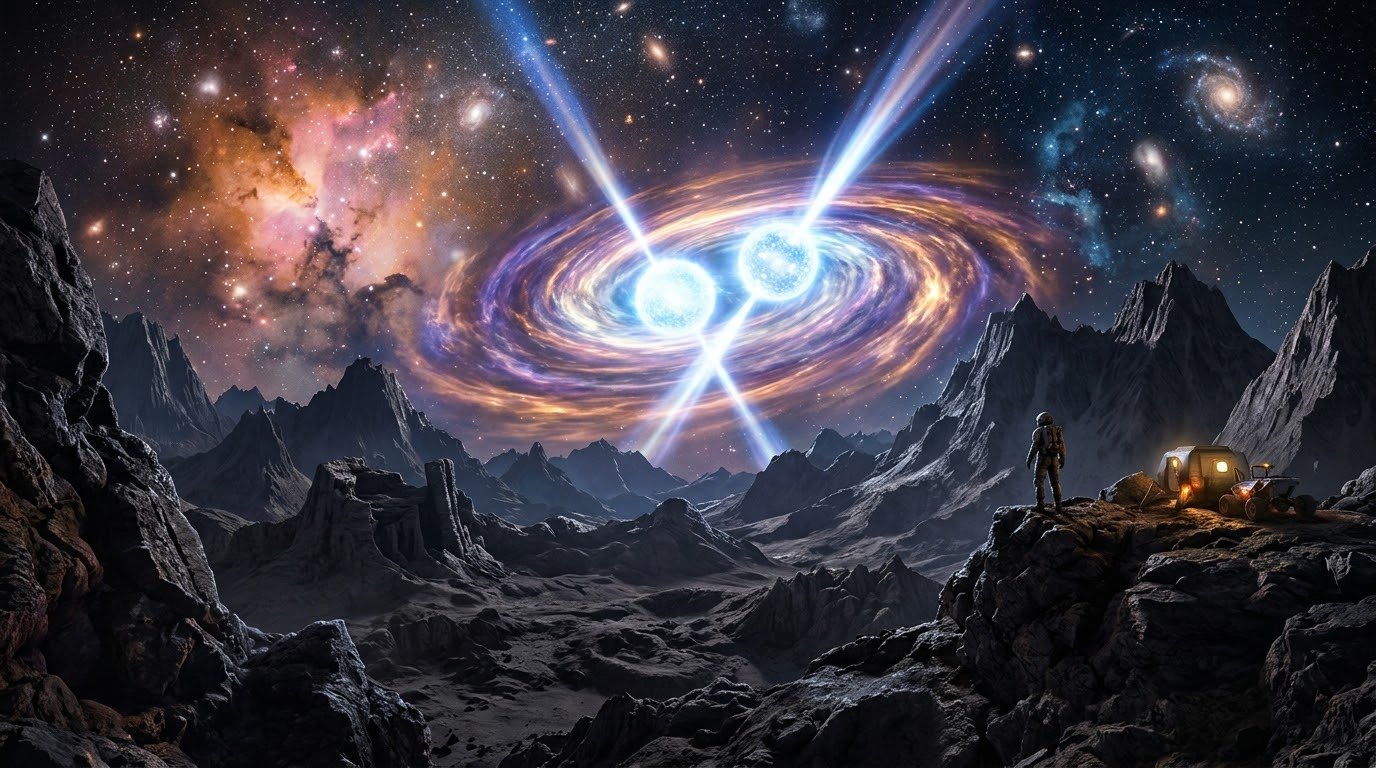
Neutron stars do not always live in isolation; many exist in binary systems where two massive stellar remnants orbit one another in an eternal gravitational dance driven by the emission of gravitational waves. As Einstein’s general relativity predicts, these orbiting heavyweights constantly bleed orbital energy through spacetime ripples, spiraling inward over billions of years until they finally collide in a cataclysmic event known as a kilonova.
The collision of two neutron stars releases a fraction of their rest-mass energy in gravitational waves, followed by a brilliant flash of light and a titanic explosion that dwarfs ordinary supernovae. This violent collision site acts as the universe’s premier nuclear foundry, providing the extreme neutron-rich environment and high temperatures necessary for the rapid neutron-capture process, or r-process.
During this fleeting event, seed nuclei capture free neutrons in rapid succession, synthesizing vast quantities of the periodic table’s heaviest elements, including platinum, uranium, and gold. Modern astronomy confirmed this cosmic alchemy in 2017 with the detection of gravitational wave event GW170817, paired with optical follow-ups that identified the spectroscopic signature of freshly forged precious metals.
Every gold ring or platinum artifact worn on Earth carries the literal genetic signature of ancient neutron star collisions — forged in the violent crucible of deep space long before our solar system was born.
Neutron stars stand as enduring testaments to the fierce, transformative power of the cosmos, bridging the gap between quantum mechanics and general relativity in a single tangible object. Born from the fiery death throes of massive giants, they represent the absolute limit of stable matter before gravity claims total victory and creates a black hole.
Their extreme densities, rapid rotations, staggering magnetic fields, and role as galactic alchemists elevate them from simple astronomical curiosities to essential cornerstones of modern astrophysics. As human instruments become more sensitive and multi-multi-messenger astronomy opens new windows into the universe, these dense remnants will continue to challenge our understanding — whispering the deepest secrets of nature from the dark corners of space.
As human instruments become more sensitive and multi-messenger astronomy opens new windows into the universe, these dense remnants will continue to challenge our understanding — whispering the deepest secrets of nature from the dark corners of space.