 Marine Evolution
Clash of the Titans: What Megalodon and the Blue Whale Reveal About Ocean Evolution
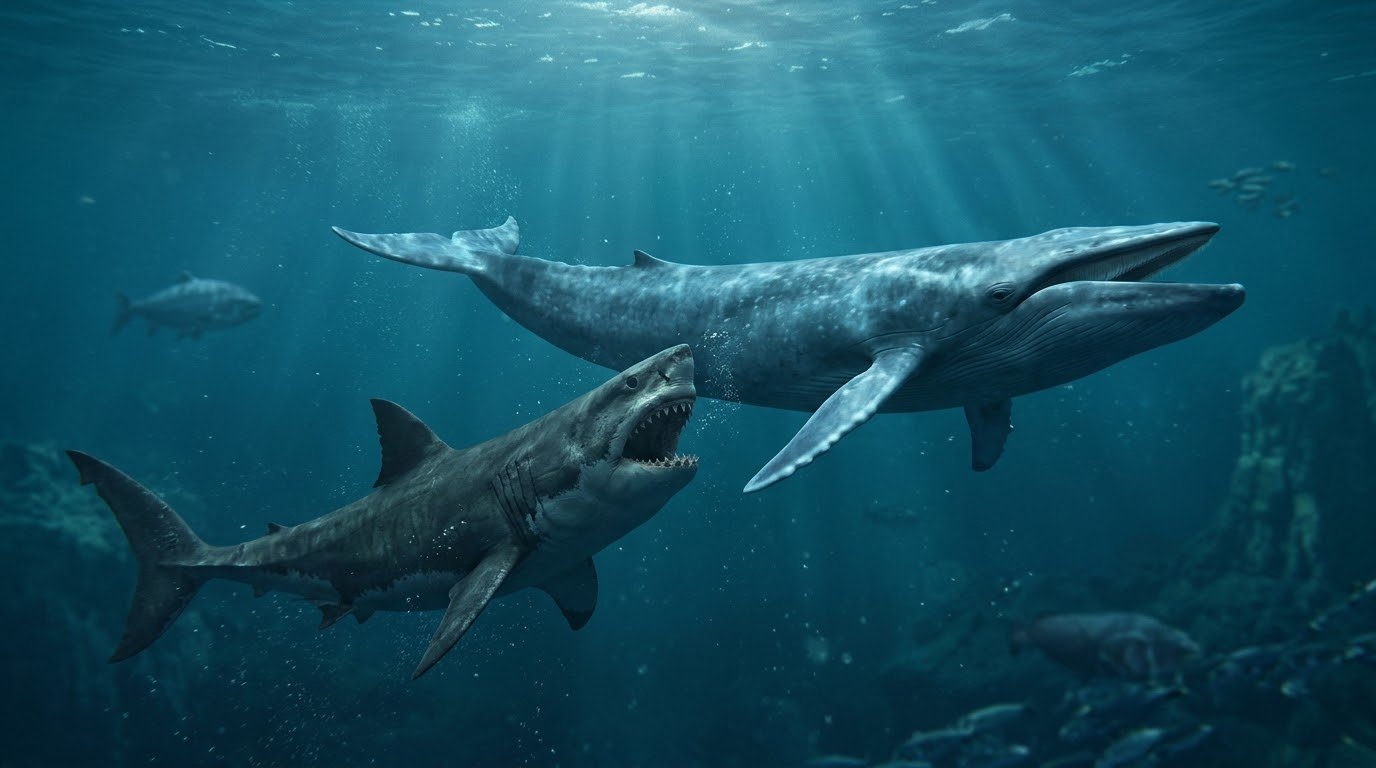
Earth’s oceans have hosted biological wonders across geological epochs, yet two marine titans define the ultimate physical ceiling of vertebrate existence: Otodus megalodon, the apex macropredator of the Neogene seas, and Balaenoptera musculus, the modern blue whale. Placing these two leviathans side by side transcends simple monster-versus-beast pop-culture curiosity; it provides an empirical lens through which evolutionary biologists evaluate biomechanics, metabolic scaling, trophic dynamics, and macroecological transitions.
Megalodon
Otodus megalodonBlue Whale
Balaenoptera musculusReconstructing Otodus megalodon relies almost entirely on fossilized teeth and mineralized vertebral centra, as cartilage degrades far faster than dense skeletal matrix. Biomechanical models derived from modern lamniform analogues indicate that this hyper-carnivorous shark reached lengths between fifteen and twenty meters, with mass estimates exceeding sixty metric tons.
Its bite force, estimated up to 180,000 Newtons, was specifically calibrated by natural selection to fracture the robust ribcages of Miocene baleen whales, disabling prey through massive structural trauma.
The apex predator of the past did not conquer the seas through sheer weight alone; it engineered a bite force capable of cracking the evolutionary shield of marine giants.
Shabab Ali
In stark contrast, the blue whale represents the absolute zenith of body mass in the history of life on Earth, dwarfing even the largest sauropod dinosaurs. Stretching up to thirty meters in length and weighing near two hundred metric tons, Balaenoptera musculus achieved its staggering bulk not through predatory violence, but through hyper-efficient filter feeding.
The architectural miracle of the blue whale lies in its metabolic efficiency: it consumes millions of tiny krill per day using massive baleen plates while expending minimal energy relative to its immense volumetric intake.
The physiological divergence between these two giants highlights a fundamental law of marine ecology: metabolic heating dictates growth ceilings for cold-blooded versus warm-blooded ocean species.
Mesothermic Shark
Required continuous intake of high-calorie fatty blubber to maintain internal body temperature. Powered high-speed hunting bursts through warm, shallow coastal waters.
Energy-expensive — limited by the availability of dense prey fields in a narrow thermal band.
Full Mammalian Endotherm
Equipped with a fully mammalian endothermic furnace, insulated by thick blubber. Exploits cold polar feeding grounds where planktonic blooms explode in density during summer thawing cycles.
Energy-efficient at scale — its massive body retains heat passively, allowing longer foraging range.
Trophic placement reveals the divergent structural roles these creatures played in their respective geological eras. Megalodon sat at the absolute top of a complex Miocene marine food web, keeping populations of early cetaceans, pinnipeds, and large sea turtles in strict ecological balance.
Its extinction roughly 3.6 million years ago — triggered by ocean cooling, dropping sea levels, and competition from newly emerging agile predators like ancestors of the killer whale (Orcinus orca) — released baleen whales from intense predation pressure, allowing them to evolve toward the unprecedented gigantism seen in blue whales today.
Extinction at the top of the food chain is not an end to life; it is the ecological permission slip for another lineage to scale the heights of gigantism.
Shabab Ali
Hydrodynamic design further illustrates how distinct evolutionary pathways solved the challenge of moving massive bulk through dense liquid mediums.
Rigid Fusiform Ambush
Hydrodynamically rigid cartilaginous body propelled by a powerful crescent tail fin. Optimized for sudden accelerations during stealth ambush strikes from deep water.
Streamlined Long-Distance
Ultra-streamlined, flexible body plan that minimizes drag during long-distance transoceanic migrations between tropical breeding lagoons and Antarctic foraging zones.
Comparative biomechanics reveals contrasting evolutionary solutions for respiratory overhead and oxygen transport during prolonged deep dives.
Obligate Ram Ventilation
Extracted dissolved oxygen continuously from seawater through massive branchial gill slits. Required constant forward motion to avoid suffocation — an evolutionary constraint that shaped both its hunting style and its range.
Powerful — but locked to continuous swimming.
Mammalian Diving Reflex
Relies on specialized cardiovascular adaptations: a massive heart weighing up to 400 pounds, extreme myoglobin concentrations in muscle tissue, and a conscious respiratory drive that permits selective organ perfusion during deep foraging dives.
Efficient — can pause, dive, and re-emerge without losing momentum.
Analyzing these marine titans offers vital insights into the vulnerability of modern ocean ecosystems under rapid climate shifts.
Collapse by Cooling
Megalodon collapsed when environmental cooling shifted ocean currents and dispersed its concentrated prey reserves into polar zones it could not efficiently inhabit. Its warm-water metabolism was locked out of the new marine geography.
Vulnerability by Warming
Today, the blue whale faces a strikingly parallel risk: rising ocean temperatures alter ocean acidification and disrupt krill aggregation patterns — proving that even the largest creatures in planetary history remain precariously bound to the health of the microscopic marine base.
The ocean’s largest predators are the first to feel the water change. Their ghosts are the ocean’s oldest warnings — and its most urgent ones.
Two titans, separated by three million years, tell the same story — even the mightiest species remain bound to the health of the microscopic marine base.