 AI & Cognition
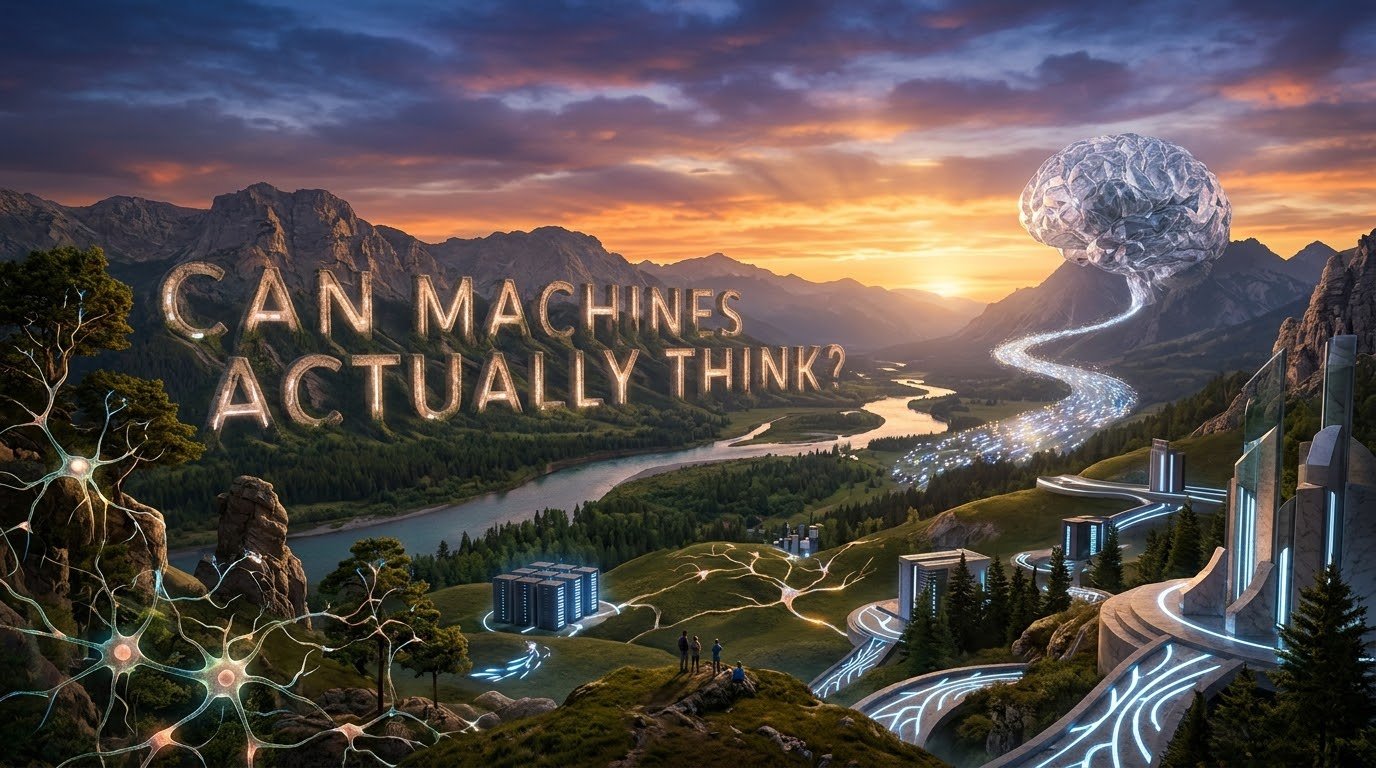
Can Machines Actually Think? Human Intelligence, Logical Reasoning and the Limits of Artificial Intelligence
Can machines actually think? This question has evolved into one of the most profound philosophical and scientific debates of our modern era. When we observe advanced artificial intelligence models generating coherent text, solving complex equations, or interacting with human-like fluidity, it is easy to assume there is a conscious mind working behind the screen.
However, reality stands in stark opposition to this illusion. The dazzling brilliance of AI is merely a sophisticated projection built entirely on code, mathematics, and massive datasets. In this comprehensive analysis, we dismantle this illusion and examine the unbridgeable gulf between human intelligence and artificial simulation.
Machine learning algorithms never generate novel autonomous intent; they simply execute statistical pattern matching across historical archives. The contrast with biological cognition is not one of degree — it is a contrast of kind.
Statistical pattern matching across historical archives.
Decisions weighed against visceral emotions, childhood imprints, personal struggles, and contextual stressors.
Zero subjective awareness or phenomenological consciousness — purely a probability calculator predicting subsequent tokens.
Conscious deliberation, inner life, and felt experience embedded in every judgment.
When an algorithmic engine defeats a grandmaster, it experiences no elation — merely solving a high-dimensional matrix.
Victory is felt as triumph — a rush of elation, relief, and meaning woven into identity.
Terminates precisely where deterministic data ends.
True intelligence initiates precisely where data terminates — constructing entirely novel paradigms through raw intuition.
This is the first and most fundamental boundary. Everything that follows — logical reasoning, data dependency, creativity, and intentionality — radiates from this single divergence: machines compute, humans experience.
Logical execution and deep conceptual reasoning present outward similarities while sharing entirely disparate internal architectures.
Rigid Conditional Branches
Restricted to rigid conditional branches, deterministic if-else checks, and sequential loop executions.
Layered Ethical Judgment
Decisions integrate multi-layered ethical boundaries, unwritten social contracts, and dynamic moral nuances.
If an autonomous vehicle encounters an unprecedented ethical dilemma demanding an immediate split-second arbitration between human life and structural law, the system inevitably collapses due to a fatal lack of common sense.
Common sense remains the ultimate hidden catalyst — completely absent from silicon processors, regardless of parameter scaling or neural network depth.
Contemporary artificial intelligence operates fundamentally as an exceptionally refined imitator rather than an original pioneer of thought.
Large Language Models ingest extensive textual repositories to mimic cognitive competence. Expose them to a scenario absent from their pre-training corpus, and the system degrades into hallucination or absolute failure. Humans, by contrast, improvise in uncharted terrain through generalizable cognitive agility.
This absolute dependency on historical training distributions proves that machine output constitutes a simulation of thought rather than genuine cognition. Innovation, by contrast, requires stepping beyond the known distribution — precisely where silicon fails and biology excels.
The attribution of authentic creativity to automated pipelines remains one of the most widespread misconceptions of the digital age.
Optimization Without Purpose
Generative tools execute algorithmic optimization routines — devoid of internal motivation, emotional turmoil, or artistic purpose.
Depth From Lived Experience
Human artistic expression draws its profound depth from existential suffering, triumph, cultural resonance, and lived experience that cannot be compiled into binary registers.
Intentionality — the intrinsic drive to execute an action for a personally held reason — belongs exclusively to biological agents endowed with subjective will. Unless an architecture develops self-directed agency and intrinsic motivation, labeling it as a thinking entity remains fundamentally inaccurate.
The central strategic error in contemporary technological discourse involves mistaking a high-performance utility for a sentient sovereign.
Tool, Not Sovereign
Artificial intelligence serves as an extraordinarily powerful lever to augment human productivity — yet it can never supplant the seat of conscious agency.
Elevate the Masters
Future civilization will elevate individuals who master computational leverage over systems, rather than those who surrender their cognitive autonomy to automation.
Biological Uniqueness
The biological brain’s infinite neural plasticity, emotional depth, and contextual adaptability remain forever unmatched by any prospective supercomputer architecture.
Cultivate, Don’t Cower
Rather than succumbing to speculative techno-fear, society must double down on cultivating distinct human capabilities — because authentic sapience remains exclusively ours.
Rather than succumbing to speculative techno-fear, society must double down on cultivating distinct human capabilities, because authentic sapience remains exclusively ours.