 Astrophysics
The Architecture of Absolute Collapse
The universe is built on a series of carefully balanced forces, but black holes represent the exact moment when the balance breaks forever. When a massive star runs out of nuclear fuel, the thermal pressure pushing outward vanishes, leaving behind an overwhelming downward crush of self-gravity. In that single collapse, matter is forced into a volume so infinitely small that standard physics loses its ability to calculate the outcome. Gravity ceases to be a mere attracting force and transforms into a geometric prison from which not even the fastest speed in the universe — the speed of light — can escape.
To understand why light succumbs to gravity, one must abandon the Newtonian picture of gravity pulling on mass. Under Albert Einstein’s General Relativity, gravity is the curvature of spacetime itself caused by mass and energy. Light always travels along the straightest possible path through space, known as a geodesic. However, when an object becomes dense enough, it warps the surrounding fabric of spacetime so severely that all paths curve inward. Light does not slow down; rather, the very roads it travels on are bent back toward the center.
A black hole is not a place of empty darkness; it is the ultimate victory of geometry over matter.
Shabab Ali
The boundary where the escape velocity equals the speed of light is known as the event horizon. Crossing this line is not like hitting a solid wall; it is a point of absolute causal disconnection from the rest of the cosmos. Everything that passes inside is stripped of its capability to transmit information to the outside universe, creating an information barrier that divides reality into two distinct realms.
Schwarzschild Radius
The mathematical threshold defining the size of a non-rotating event horizon based strictly on mass.
Photon Sphere
A region just outside the horizon where gravity is so precise that photons are forced to orbit the black hole in unstable circles.
Ergosphere
A region surrounding a rotating black hole where spacetime itself is dragged along at speeds exceeding the speed of light relative to distant observers.
Crossing an event horizon is not a transition in space, but a total surrender of future time.
Shabab Ali
Spaghettification
Beyond the event horizon lies a phenomenon of severe tidal forces. Because gravitational pull weakens with distance, the force exerted on an object’s leading edge is vastly stronger than on its trailing edge. For stellar-mass black holes, this difference stretches any incoming structure into a thin, continuous stream of subatomic particles before it ever reaches the core.
At the center of a non-rotating black hole lies the gravitational singularity, a location where density and spacetime curvature reach infinity. Here, General Relativity predicts its own downfall because quantum mechanical forces can no longer be ignored, yet no unified theory of quantum gravity exists to describe the state of matter under such extreme conditions.
The existence of singularities forces astrophysicists to deal with the cosmic censorship hypothesis, which posits that all real singularities are safely hidden behind event horizons. Without an event horizon to shroud a singularity, a “naked singularity” would destroy the causal predictability of the universe, allowing unpredictable quantum effects to influence macro-level realities.
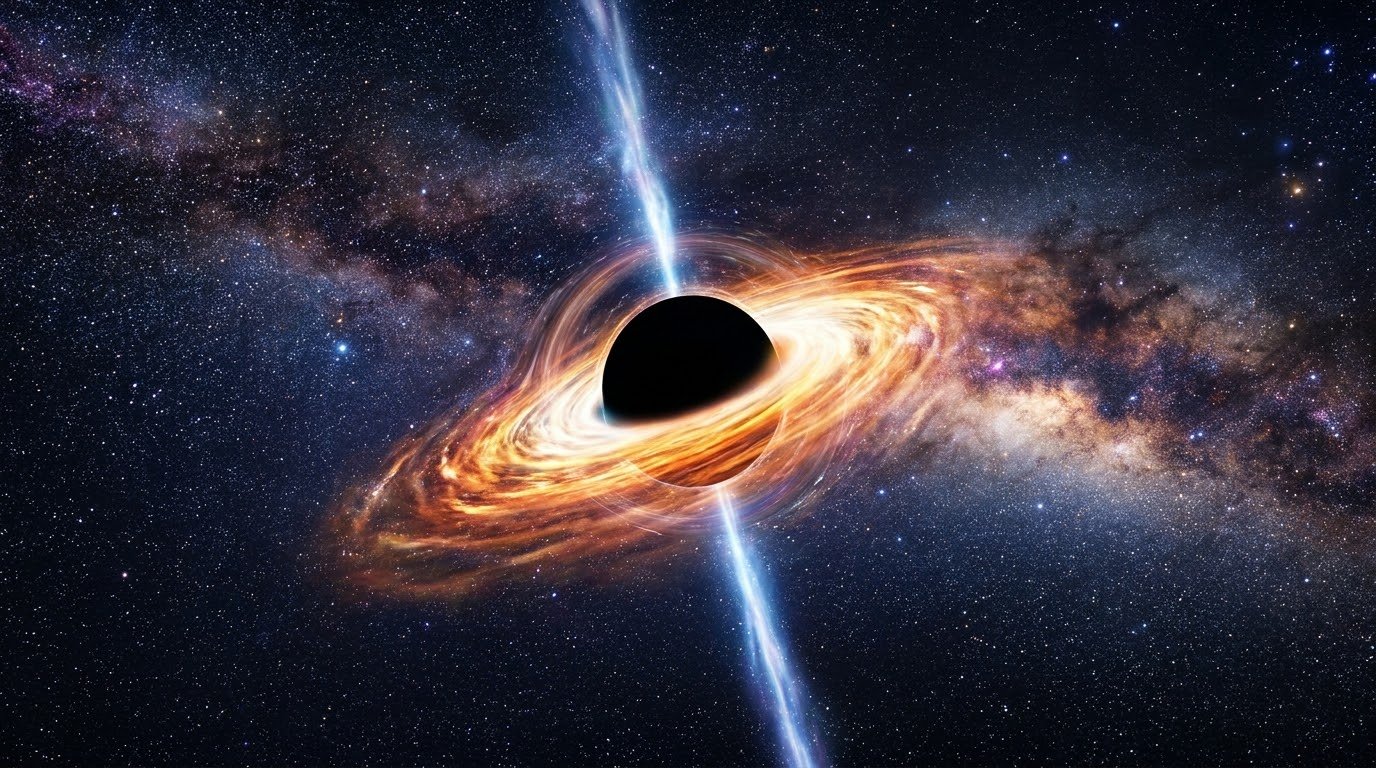
Even though black holes themselves emit no light directly, their immediate environments rank among the brightest phenomena in the cosmos. Gas, dust, and disrupted stars falling toward the event horizon form a hyper-hot, rotating structure known as an accretion disk. Internal friction within this disk accelerates particles to relativistic speeds, transforming gravitational potential energy into intense thermal radiation across the electromagnetic spectrum.
Magnetic fields within the accretion disk can become wrapped and twisted around the black hole’s spin axis. This magnetic funneling directs superheated plasma away from the event horizon, launching relativistic jets that span thousands of light-years into intergalactic space. Through these jets, a black hole actively shapes its parent galaxy by regulating star formation rates and redistributing heavy elements.
The brightest beacons in the night sky are powered by the deepest shadows in space.
Shabab Ali
For decades, black holes were believed to be completely cold and everlasting, but quantum field theory in curved spacetime changed that perspective. Near the event horizon, virtual particle-antiparticle pairs constantly form and annihilate. Occasionally, one particle falls inside while the other escapes, causing the black hole to slowly lose mass over astronomical timescales — a process known as Hawking radiation.
This evaporation mechanism gives rise to the black hole information paradox. If a black hole evaporates completely, all quantum information regarding the matter that originally formed it appears to be erased. Because standard quantum mechanics mandates that information must always be conserved, this contradiction remains one of the greatest unresolved challenges in theoretical physics today.
To solve the black hole information paradox is to discover the fundamental alphabet of reality.
Shabab Ali
The study of black holes shifted from theoretical mathematics to empirical observation with the advent of gravitational wave astronomy. Detectors like LIGO and Virgo measure ripples in the fabric of space caused by the violent collision and merger of binary black hole systems. These signals provide direct, precision testing of General Relativity in the strongest gravitational fields imaginable.
LIGO & Virgo Detectors
Measure ripples in the fabric of space caused by the violent collision and merger of binary black hole systems — providing direct precision testing of General Relativity in the strongest gravitational fields imaginable.
Event Horizon Telescope
Radio-telescope arrays have captured direct shadow images of supermassive black holes in M87 and Sagittarius A* — confirming the photon ring and validating decades of mathematical modeling of warped spacetime.
The frontier of black hole research now drives the search for a unified Theory of Everything. By examining string theory, loop quantum gravity, and holographic principles through the lens of extreme gravity, scientists are unlocking how space, time, matter, and energy interact at the fundamental level.
The black hole is no longer viewed merely as an engine of destruction, but as the ultimate cosmic laboratory for the future of physics.
The black hole is not merely an engine of destruction — it is the ultimate cosmic laboratory for the future of physics.