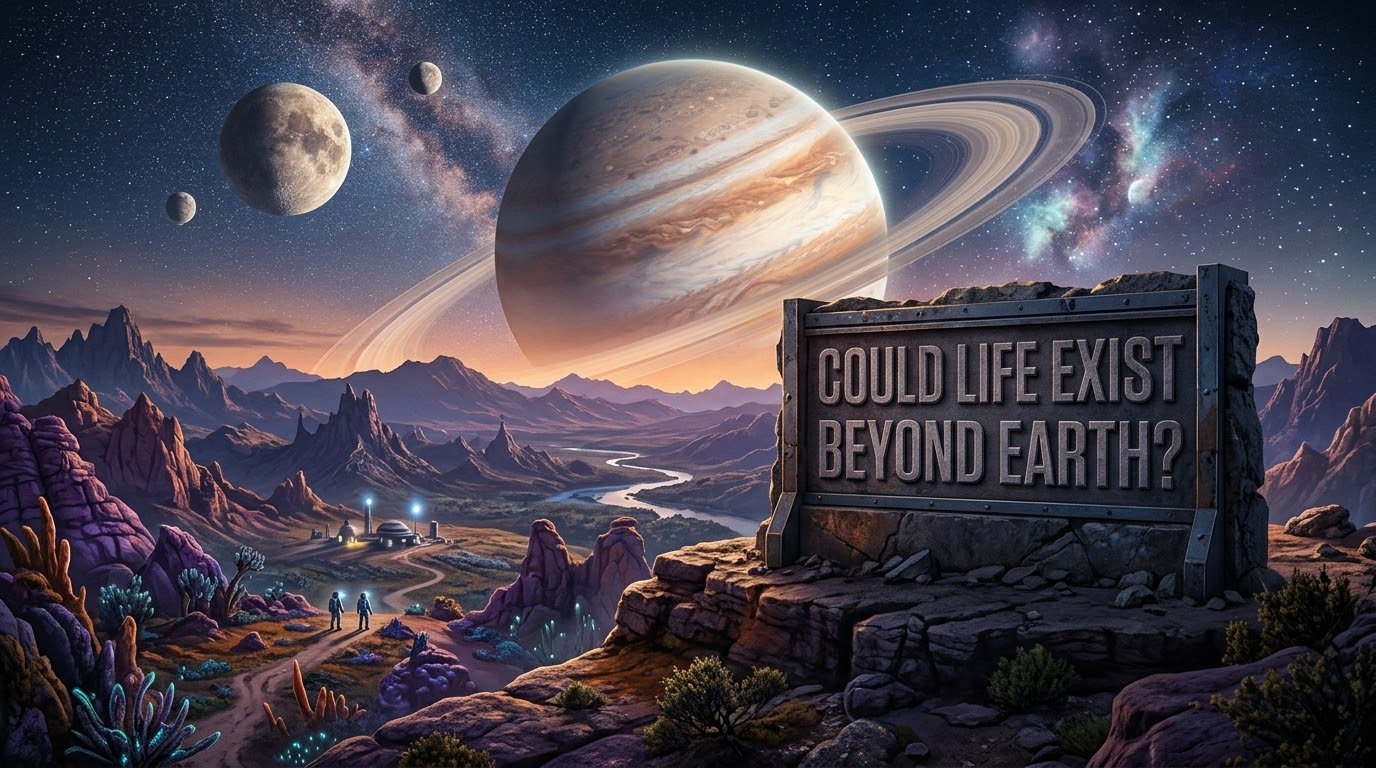
 Astrobiology
Beyond Our Blue Horizon: The Rigorous Scientific Search for Extraterrestrial Life
The cosmos has long whispered to humanity, transforming our ancient nocturnal wonder into a disciplined modern empirical quest. For generations, looking up into a starry canopy felt like gazing at a silent gallery of distant lamps, but contemporary astrophysics and astrobiology have fundamentally rewritten that premise.
We now know that the universe is not a sterile desert of inert rock; it is a dynamic, chemically rich laboratory brimming with the raw ingredients of biology. The central question of whether life exists beyond Earth has shifted from a philosophical speculation to one of the most testable, rigorous hypotheses in modern science.
We are not peering into the dark emptiness of space hoping for a miracle; we are reading an ancient biological manuscript written across the stars.
Shabab Ali
Every stellar nursery across the Milky Way forges complex organic molecules in interstellar clouds before planets even coalesce. Carbon, hydrogen, nitrogen, oxygen, phosphorus, and sulfur — the fundamental building blocks of terrestrial biochemistry — are among the most abundant atomic species in the cosmos.
When ultraviolet radiation and cosmic rays strike freezing interstellar dust grains, they spontaneously catalyze amino acids, simple sugars, and nucleotide precursors. This universal ubiquity of organic chemistry suggests that the chemical grammar of life is written into the fundamental laws of physics, waiting only for the right thermodynamic conditions to spell out living sentences.
Within our own solar system, the traditional habitable zone — once defined strictly as the narrow orbital band where liquid water could pool on a planet’s surface — has expanded dramatically. Moons orbiting the distant gas giants of the outer solar system harbor vast, subterranean global oceans heated by intense tidal friction.
Europa
Beneath its cracked ice shell lies a salt-water ocean containing twice the water of all Earth’s oceans combined, warmed by Jupiter’s tidal forces.
Enceladus
Cryovolcanic plumes erupt from its south pole, venting water vapor and complex organics from a subsurface ocean into space — a direct sample of alien chemistry.
Titan
An entirely different biochemistry — liquid methane and ethane lakes, hydrocarbon dunes, and a nitrogen haze. Chemistry beyond water.
Beneath the thick, protective ice crusts of Europa and Enceladus, hydrothermal vents pump mineral-rich thermal energy directly into pitch-black liquid water. These hidden abyssal environments mirror the terrestrial deep-sea floor where chemosynthetic ecosystems thrive completely independent of solar radiation, proving that life does not strictly require a sunlit surface to ignite and sustain itself.
Titan, the enigmatic moon of Saturn, presents an entirely distinct paradigm of biochemistry by substituting liquid water with cryogenic lakes of liquid methane and ethane. Organic precipitation constantly washes down its hazy nitrogen atmosphere, creating dune fields of complex hydrocarbons that could theoretically support speculative metabolic pathways operating at minus one hundred and eighty degrees Celsius. Exploring these diverse planetary bodies forces astrobiologists to decouple their definitions of life from terrestrial water-and-DNA chauvinism, embracing a broader spectrum of biochemical possibilities.
Beyond our local neighborhood, the Kepler and TESS space telescopes have revealed that planets outnumber stars in our galaxy, transforming exoplanetology from a speculative subfield into a high-precision observational science. Thousands of alien worlds now populate our stellar census, ranging from scorching ultra-short-period hot Jupiters to temperate, rocky super-Earths locked in synchronous orbits around cool red dwarf stars.
Detecting these worlds relies on ingenious indirect methods, primarily measuring the minute photometric dip in starlight as an exoplanet transits its host star, or tracking the gravitational radial velocity wobble imparted on the parent star by an orbiting mass.
Photometric Dimming
As a planet crosses in front of its star, it blocks a fraction of the light — producing a tiny, repeating dip detectable across hundreds of light-years.
Gravitational Wobble
An orbiting planet tugs on its star, causing a subtle back-and-forth wobble measurable through shifts in the star’s spectral lines.
Characterizing these distant atmospheres represents the bleeding edge of spectroscopic innovation, allowing scientists to hunt for chemical disequilibrium as a biosignature. When starlight filters through an exoplanet’s gaseous envelope during a transit, specific molecular absorption lines imprint a unique chemical fingerprint onto the photon spectrum.
Absorption lines reveal which molecules exist in an exoplanet’s atmosphere. Simultaneous detection of oxygen, methane, and water vapor may signal life.
The simultaneous detection of atmospheric oxygen, ozone, methane, and carbon dioxide creates a compelling circumstantial case for biological activity, because these reactive gases would naturally neutralize each other over geological timescales unless continuously replenished by living organisms.
An alien world does not need to whisper in our language; its atmosphere will speak through the silent, undeniable chemistry of life.
Shabab Ali
The Search for Extraterrestrial Intelligence tackles the cosmic equation from a complementary technological angle, scanning the electromagnetic spectrum for artificial technosignatures rather than microbial metabolic byproducts. Modern radio arrays and optical SETI initiatives sift through billions of narrow-band frequency channels, searching for deliberate carrier waves, pulsed laser transmissions, or industrial atmospheric pollutants like chlorofluorocarbons.
Natural cosmic radio emission is broad and noisy. A deliberately broadcast signal would appear as a razor-thin, coherent spike — an unmistakable technosignature.
While decades of listening have yielded only cosmic silence, our observational sensitivity has increased by orders of magnitude, effectively expanding our radio search volume from the scale of a swimming pool to the entire galactic ocean.
The philosophical implications of discovering even rudimentary microbial life elsewhere in the universe would immediately revolutionize our understanding of our own cosmic standing. Finding a second, independent genesis of life within our solar system — perhaps preserved in the subsurface mud of Mars or the cryovolcanic plumes of Enceladus — would mathematically prove that biology is a cosmic imperative rather than an improbable statistical anomaly.
A Cosmic Imperative
Life is not rare — it emerges wherever energy gradients and stable solvents coexist. Our galaxy teems with living processes. The universe becomes a biological tapestry rather than a sterile void. Humanity is one voice in a crowded cosmic chorus.
A Sacred Solitude
Earth is an isolated biological oasis. Human consciousness becomes a rare, precious spark — the universe waking up to contemplate its own architecture. Our blue planet gains unprecedented cosmic value, demanding stewardship of a cosmic treasure.
Conversely, confirming that Earth is an isolated biological oasis in a vast, dead cosmos would elevate our fragile blue planet to an unprecedented level of cosmic stewardship. It would frame human consciousness as a rare, precious spark — the universe waking up and developing the capacity to contemplate its own magnificent architecture.
Whether we ultimately discover complex technological civilizations or single-celled extremophiles clinging to subsurface rocks, the relentless pursuit of this answer unites humanity in a shared intellectual journey that transcends all earthly borders.
Whether we find a thousand alien biospheres or confirm that we are alone, the quest itself is a mirror — one that reveals who we are, and what we are willing to become.