 Cosmology
What Lies Beyond the Observable Universe? The Limits of Human Knowledge
The visible cosmos is merely a brightly lit room in a dark, infinite mansion whose doors we can never open. When astronomers gaze into the night sky through instruments like the James Webb Space Telescope, they are not looking at reality as it is today, but rather at ghost lights — ancient photons that have traveled billions of years to reach our mirrors.
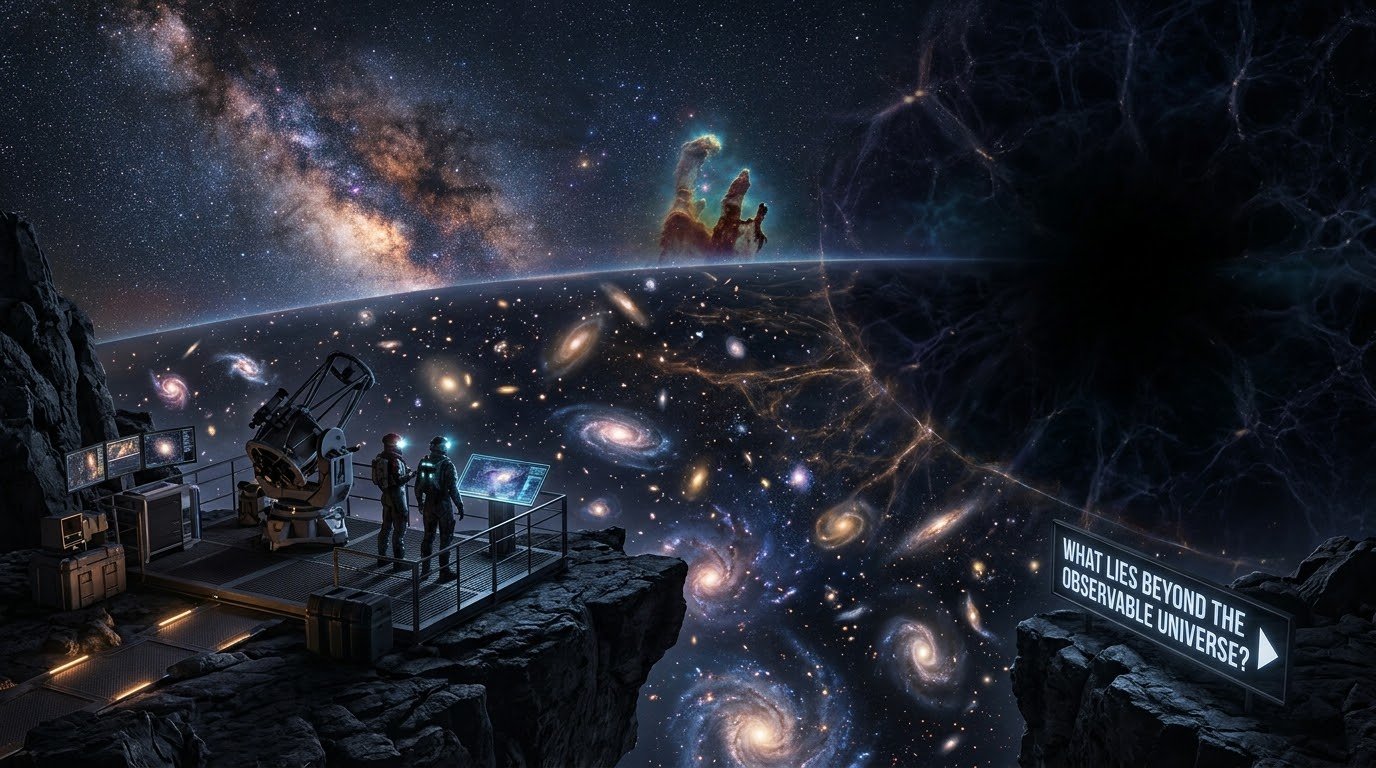
Light has a finite speed of roughly 300,000 kilometers per second, and because the universe is approximately 13.8 billion years old, photons from sources further than 46.5 billion light-years away simply have not had enough time to reach us since the Big Bang. This hard physical barrier defines our observable bubble — a spherical horizon centered entirely on Earth that traps human curiosity within a finite cage of starlight.
We are prisoners of a cosmic speed limit, trying to measure an eternity with a ruler made of fading light.
Shabab Ali
Beyond this shining boundary exists the unobservable universe — a realm where space itself expands faster than the speed of light, carrying distant galaxies away from us into a permanent, unbridgeable silence. Cosmologists calculate that if our observable universe represents a single grain of sand, the entire cosmos might be trillions of times larger, or perhaps completely infinite in its terrifying, boundless expanse.
Every photon that reaches our telescopes has been traveling for billions of years. What we see is not the universe as it is — it is the universe as it once was, a fossilized lightscape frozen at the moment each photon began its journey toward us. The further we look, the further back in time we peer.
To understand what lies out there, we must first confront the geometry of the multiverse, where our universe is likely just one bubbling pocket in an endless sea of inflating quantum foam. Eternal inflation theory suggests that while the Big Bang created our local bubble, other regions of space are inflating exponentially, spawning entirely separate universes with completely different physical laws, constants, and dimensions.
In some of these parallel realms, gravity might be repulsive rather than attractive, while in others, stars may never have formed because chemistry itself operates under alien rules incomprehensible to human physics. These sister universes do not exist side-by-side in our familiar three-dimensional space; instead, they are separated by impassable quantum barriers or dimensions that defy any spatial metaphor our brains evolved to process.
Infinity is not a very big number; it is a violent rejection of boundaries where every conceivable reality is forced to happen.
Shabab Ali
Another mind-bending possibility proposed by theoretical physicists is the existence of the cosmic horizon as a dynamic mirror rather than an empty void, hinting at a cyclic universe model. In this framework, our expanding universe will eventually undergo a massive crunch or a perpetual drift into absolute zero, only to trigger a new genesis where space restarts its clock with a clean slate.
Yet, even if we never witness what lies beyond our horizon, the laws of quantum mechanics whisper strange secrets about the absolute edges of reality. Quantum entanglement proves that information can transcend distance instantaneously, suggesting that at a subatomic level, the universe is fundamentally non-local and deeply interconnected in ways that make space and time look like mere illusions.
Perhaps the boundary of the observable universe is not a physical wall of stone and fire, but a cognitive horizon marking the absolute limit of what mathematics and human consciousness can decode. We are biological computers running on evolutionary software designed to hunt and gather on the plains of a minor planet, struggling to comprehend the architecture of dimensions that operate beyond the stars.
Human knowledge is a glowing matchstick struck in a hurricane; it illuminates our immediate fingertips while the true architecture of the night remains untouched.
Shabab Ali
Consider the topological shape of the universe itself, which could be flat, spherical, or shaped like a gigantic cosmic donut known as a three-torus. If space is finite yet bounded without any edges — much like the surface of a globe where walking in a straight line brings you back to your starting point — then looking far enough might theoretically project light back to our own past.
Advanced computer simulations and cosmic microwave background radiation maps constantly search for repeating patterns in the sky, testing whether our universe is a hall of mirrors reflecting our own Milky Way from ancient epochs. So far, the data points toward a universe so incomprehensibly vast that any such reflections lie far beyond our technological reach, locked away behind the curtain of cosmic expansion.
Dark energy accelerates this separation every single second, pushing distant galaxies deeper into the cosmic dark and ensuring that future intelligent civilizations — if any arise billions of years from now — will look up at a completely empty, black night sky. They will have no stars to study, no cosmic microwave background to measure, and no evidence of a Big Bang, believing their tiny isolated island is the entirety of existence.
We are uniquely fortunate to live in the golden window of cosmic history where the universe is still bright enough to reveal its distant past — before the relentless expansion pulls the wool over the eyes of future observers.
To stare into the dark ocean beyond our horizon is to witness the ultimate humility of human intellect whispering against the roar of eternity.
Shabab Ali
Every breakthrough in particle physics or telescope design merely pushes the horizon further back, revealing a larger darkness rather than an ultimate wall. We map the micro-cosmos of quarks and leptons to understand the macro-cosmos of superclusters and voids, realizing with profound awe that the smallest scales of reality mirror the infinite depths of the sky.
The unknown is not a failure of science; it is the fuel that drives civilization forward, ensuring that human curiosity will never run out of questions to ask. What lies beyond the observable universe is an eternal invitation, reminding us that no matter how much we discover, we have only just begun to scratch the surface of existence.
What lies beyond the observable universe is an eternal invitation — no matter how much we discover, we have only just begun to scratch the surface of existence.