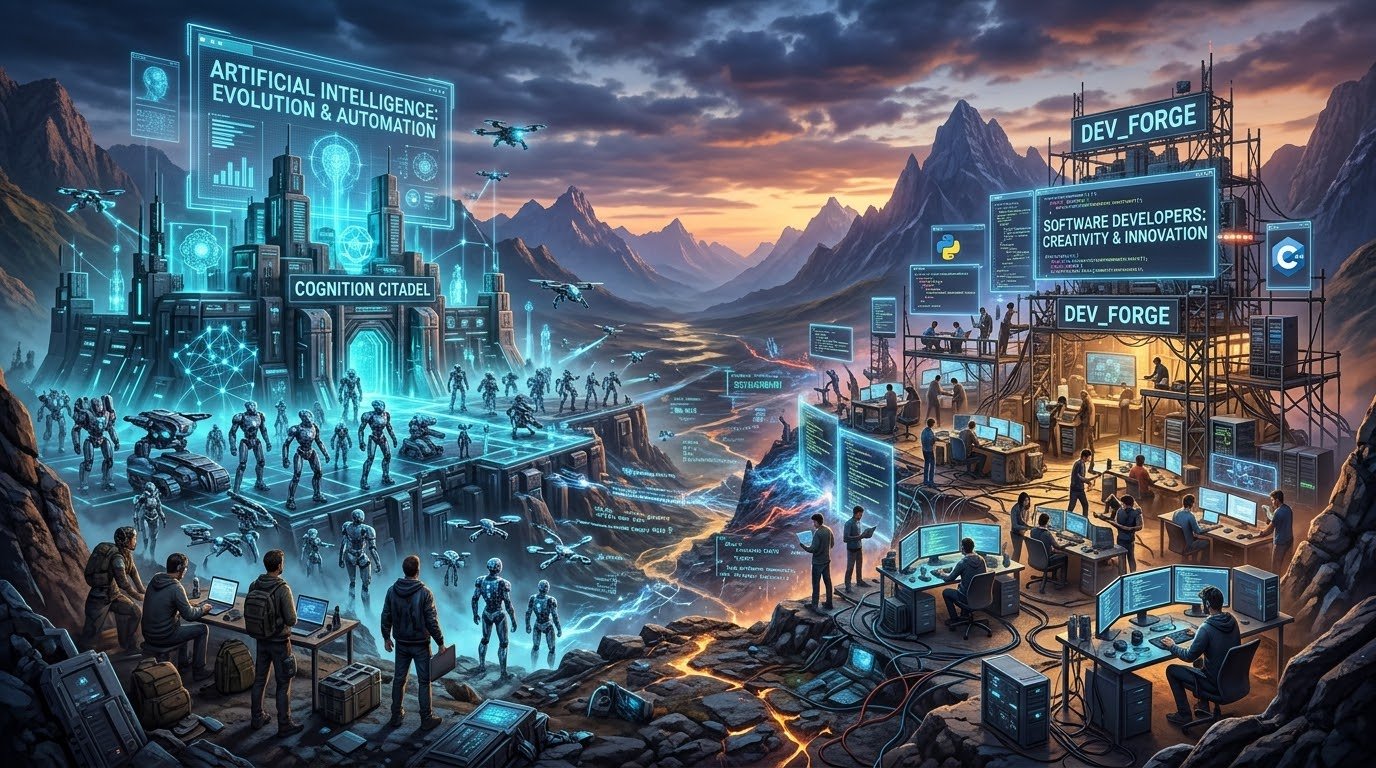
 Artificial Intelligence
AI vs Software Developers: Will Artificial Intelligence Replace Programmers—or Reward the Most Skilled?
The global software industry is undergoing an unprecedented structural transition driven by the rapid evolution of autonomous coding algorithms and generative intelligence. Traditional code assembly—once considered the apex of human cognitive work—is fast becoming a commodities marketplace where synthetic systems generate thousands of line-of-code blocks per second. This paradigm shift has triggered a profound philosophical dilemma across corporate boardrooms, engineering departments, and educational institutions worldwide. The central question is no longer whether artificial intelligence can write software, but whether it will completely dismantle the programming profession or selectively elevate an elite tier of high-order systems architects.
Industry metrics reveal that routine code generation, syntactical debugging, and repetitive unit testing are rapidly migrating toward autonomous agentic networks. This automated expansion does not signify the absolute extinction of human programmers; rather, it marks the end of low-friction, syntax-only software development. Developers relying exclusively on memorized syntax patterns, repetitive framework stitching, and basic glue code now face direct economic obsolescence as raw computational output scales infinitely.
To understand this transformation, we must analyze how individual job functions within software engineering are shifting across the AI integration spectrum.
Code-to-Spec Synthesizers
Manual QA & Test Engineers
Full-Stack Orchestrators
Principal Systems Architects
Despite rapid breakthroughs in agentic software models, artificial intelligence remains bound by fundamental structural constraints.
The Domain Context Abyss
AI systems lack physical world intuition and deep domain exposure. They evaluate statistical probabilities over text tokens rather than understanding human business operations, edge-case user motivations, or complex regulatory environments.
The Security and Hallucination Trap
Generative models frequently inject subtle architectural vulnerabilities, outdated API signatures, and unverified dependency libraries into codebases. Without rigorous human review, AI-generated code leads to massive security risks and unmaintainable technical debt.
Architectural Drift
Unchecked AI code generation fragments software architecture over time. While an AI agent can solve a single function cleanly, it cannot maintain systemic elegance, long-term database performance, or operational stability across complex multi-service networks without human oversight.
The impact of AI on software development manifests as a Tale of Two Realities, bifurcating the labor market into distinct economic outcomes.
The Entry-Level Compression
The traditional career entry ramp—built on resolving minor bug fixes, building basic interfaces, and writing simple unit tests—is shrinking rapidly. Companies rely heavily on AI tools to handle entry-level coding tasks, resulting in significantly fewer junior job openings and setting a much higher bar for early-career hires.
The Senior Value Multiplier
For experienced developers and adaptive engineers, artificial intelligence acts as a powerful force multiplier. A single highly skilled architect, leveraging autonomous AI agents, can now design, build, test, and deploy entire enterprise applications that previously required teams of fifteen developers.
To thrive in this new landscape, software engineers must systematically pivot away from low-level syntax execution toward high-value, strategic competencies.
Master Agentic Orchestration
Transition from writing code manually to directing multi-agent AI coding systems. Learn to craft precise technical specifications, validate synthetic code output, and maintain high standards of code quality.
Double Down on System Design & Security
Deepen your understanding of distributed database architectures, asynchronous microservices, zero-trust security protocols, and memory optimization. These core disciplines require human judgment that AI cannot replicate.
Bridge Business Vision with Technical Execution
Develop strong domain expertise in specific vertical industries—such as algorithmic finance, medical technology, or defense systems. The ability to translate ambiguous real-world business problems into clear technical requirements is more valuable than ever.
Artificial intelligence will not replace software developers as a whole. Instead, developers who master AI tools will replace developers who do not.
Artificial intelligence will not replace software developers as a whole. Instead, developers who master AI tools will replace developers who do not.
The industry is moving away from judging programmers by how fast they type syntax toward evaluating them on their systemic judgment, architectural vision, and problem-solving impact. As repetitive coding tasks become fully automated, the market will disproportionately reward top-tier engineers who can harness these supercomputing systems to solve humanity’s most complex challenges.