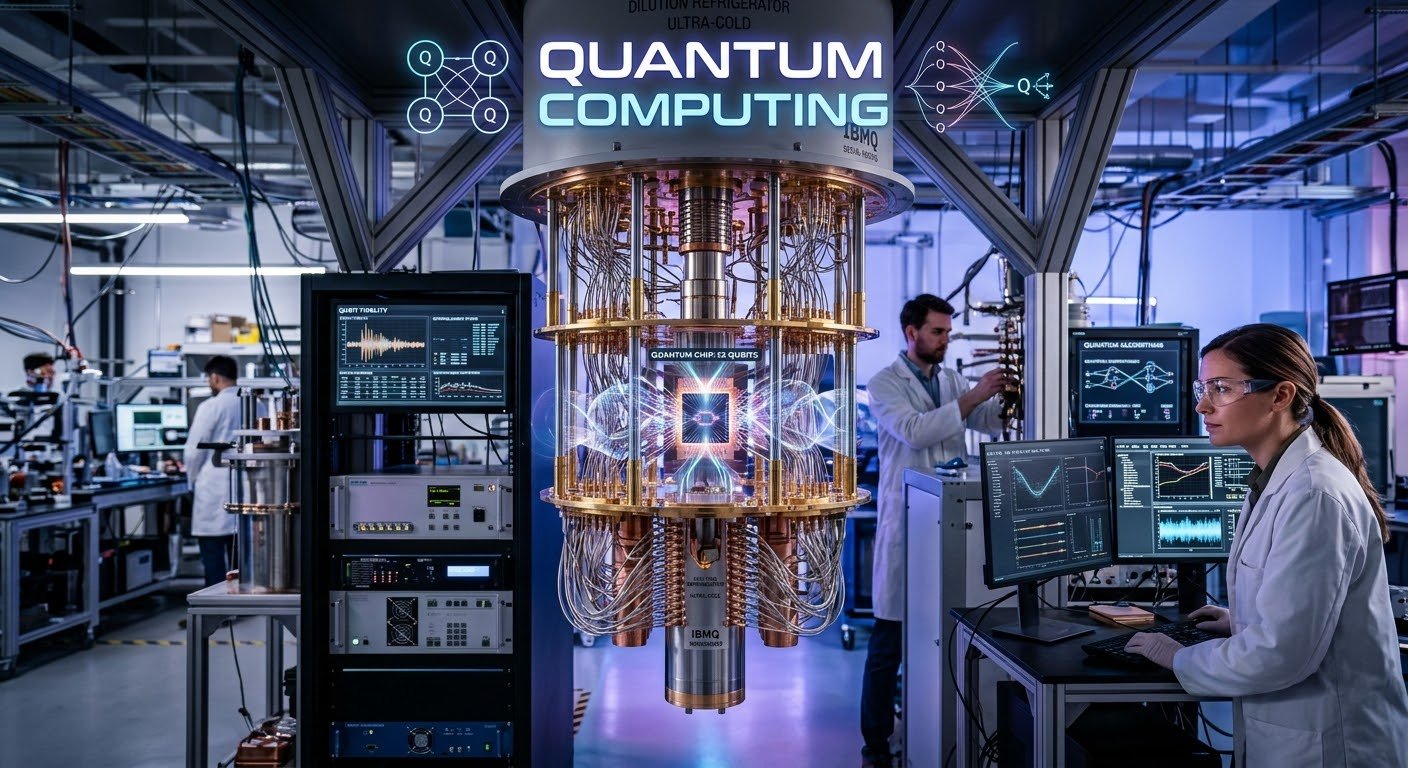
 Quantum Computing
: The Technology That Could Change What Computers Are Capable Of
Modern silicon microprocessors have hit a physical wall governed by atomic limits. When transistors shrink down to single-nanometer scales, electrons leak across gates due to quantum tunneling, making further miniaturization through traditional engineering virtually impossible. Standard computing relies entirely on binary transistors—devices that act as rigid light switches, locked into either a definite 0 or a definite 1 at any given moment. This deterministic mechanics forces classical machines to process massive calculation sets sequentially, evaluating possibilities one path after another.
While supercomputers speed up this process using parallel threads, they remain fundamentally limited by sequential logic structures. Complex global challenges—such as simulating multi-molecule chemical reactions, breaking high-grade cryptography, or calculating macro-level supply chain routes—require evaluating trillions of permutations simultaneously. This exponential explosion of possibilities renders classical computing architectures mathematically inadequate for the next generation of scientific discoveries.
Quantum computing discards classic binary architecture in favor of subatomic principles derived directly from quantum mechanics. Instead of classic bits, quantum processors utilize qubits—quantum systems such as trapped ions, superconducting circuits, or isolated photons. Qubits do not function as simple binary switches; they embody a dual physical reality governed by three foundational pillars.
The Three Foundational Pillars
Superposition
A qubit exists as a linear combination of both |0⟩ and |1⟩ simultaneously, expressed mathematically through probability amplitudes.
This state allows a system of N qubits to evaluate 2N states at once, granting exponential computational space.
Entanglement
When qubits become quantum-mechanically linked, the state of one qubit instantaneously determines the state of another, regardless of spatial separation.
This deep physical coupling forms a unified, ultra-fast internal communication fabric across the processor.
Quantum Interference
Quantum algorithms use interference patterns to amplify the probability amplitudes of correct mathematical solutions while canceling out wrong computational branches, steering the system directly toward the exact target answer.
Engineers globally are racing to build stable physical hardware capable of preserving delicate quantum states. Below is a comparison of the primary competing technological approaches currently driving quantum research.
Superconducting Loops
- MechanismTiny Josephson junction circuits cooled near absolute zero (0.01 K)
- Core AdvantageUltra-fast execution speeds, mature microfabrication processes
- Main ChallengeExtremely short coherence times, heavy cryogenic requirements
Trapped Ion Systems
- MechanismIndividual charged atoms suspended in space using electromagnetic fields
- Core AdvantageExceptionally high qubit fidelity and long coherence periods
- Main ChallengeSlower gate execution speeds, complex laser alignment requirements
Photonic Networks
- MechanismSingle photons manipulated through intricate optical chips and waveguides
- Core AdvantageRoom-temperature operation, direct integration with fiber-optic data transfer
- Main ChallengeHigh photon loss rates, non-deterministic quantum logic gates
Topological Qubits
- MechanismNon-Abelian anyons braided within semiconductor-superconductor interfaces
- Core AdvantageInherent hardware-level protection against local noise and decoherence
- Main ChallengeExtremely difficult to synthesize and demonstrate experimentally
Quantum computing is not merely an incremental speed upgrade for routine tasks; it is a fundamental shift designed to solve previously intractable problems.
Molecular Simulation & Material Science
Simulating a simple penicillin molecule requires tracking millions of electronic interactions—a task that overloads classical supercomputers. Quantum processors simulate subatomic molecular structures directly within native quantum environments. This capability drastically reduces discovery timelines for room-temperature superconductors, highly efficient solar cells, and custom pharmaceutical drug formulations.
Cryptography & Cyber Defense
Classical digital security relies heavily on the mathematical difficulty of factoring ultra-large prime numbers (such as RSA-2048 encryption). Shor’s Algorithm, running on a sufficiently powerful quantum computer, can factor these large integers in polynomial time—rendering legacy encryption methods obsolete. This breakthrough has sparked an urgent global transition toward Post-Quantum Cryptography (PQC) algorithms designed to resist quantum attacks.
Global Supply Chain & Logistics Optimization
Calculating the single optimal delivery route across thousands of dynamic global variables involves factorial combinatorial complexity (N!). Quantum Annealing algorithms evaluate these multi-dimensional configuration spaces almost instantly, promising to save billions of dollars in fuel consumption, maritime routing, and global trade operations.
Quantum Artificial Intelligence & Machine Learning
Machine learning relies on processing high-dimensional vector spaces and performing complex matrix manipulations. Quantum Machine Learning (QML) accelerates model training times, enables pattern detection in massive unstructured datasets, and unlocks advanced generative AI capabilities previously constrained by classical hardware limits.
Despite its immense potential, quantum hardware faces a critical physical limitation: Quantum Decoherence. Qubits are extraordinarily fragile systems. Minor environmental fluctuations—such as micro-temperature changes, stray electromagnetic fields, or atmospheric background radiation—cause qubits to collapse out of their superposition state back into ordinary binary noise.
To combat this instability, researchers are actively developing Quantum Error Correction (QEC) protocols. These techniques bind hundreds or thousands of physical qubits together to create a single, fault-tolerant logical qubit.
Through surface code architectures and continuous syndrome measurements, logical qubits detect and correct hardware errors on the fly without destroying the underlying quantum information.
The transition from noisy intermediate-scale quantum (NISQ) devices to fully fault-tolerant quantum supercomputers marks one of the most significant technological shifts in human history.
As quantum error rates decline and logical qubit counts scale up, humanity will gain the computational power required to solve once-impossible challenges: modeling complex atmospheric climate dynamics, discovering novel battery chemistries, and uncovering deep fundamental insights into the physics of the universe.
Quantum computing is not just an evolution of traditional electronic processors—it is the foundation of a brand-new scientific era.